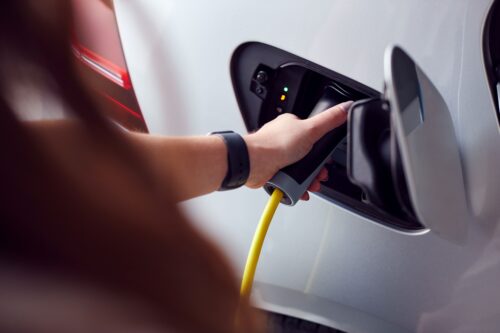
Managed charging programs for electric vehicles can drive down electricity rates and improve the grid’s ability to handle peak demand. Utilities can increase customer enrollment through clear messaging, strong incentives, smooth user experiences, and robust outreach.
Utilities across the country are grappling with rising electric demand. As more households choose EVs, electric loads could grow even further. But an emerging practice known as managed charging offers a promising way for EVs to act as grid assets and improve energy affordability.
Managed charging strategies shift when EVs are charged to times of low power demand, making better use of the grid and deferring costly utility upgrades. By enabling utilities to meet additional electricity demand using their existing infrastructure, managed charging spreads fixed costs over a higher volume of electricity sales, lowering the cost of each kilowatt-hour sold and exerting downward pressure on rates. One recent analysis found managed charging can cut grid upgrade needs by 30%, leading to significant cost savings.
To unlock these benefits, widespread managed charging of EVs is key. A recent convening of ACEEE’s EV working group for utilities highlighted best practices in the design of managed charging programs to increase enrollment and ultimately support broader goals of energy affordability and grid resilience.
Managed charging makes smarter use of existing resources
Managed charging programs can incentivize charging at optimal hours, whether through passive “time of use” (TOU) rates that charge customers less during off-peak times (typically overnight, early morning, or weekend hours) or through active programs that give the utility more direct control of when EVs charge. In some cases, managed charging programs can even fine-tune charging schedules by factoring in the capacity of the local distribution grid, offering the potential for additional optimization and systemwide value.
Utilities can collaborate with fleet managers to design rates and incentives that help shift charging demand from medium- and heavy-duty EVs. But residential customers are more decentralized and harder to reach. For individual EV owners, charging schedules are more often driven by habits, such as getting home from work and plugging in the vehicle, than by actual charging needs. Managed charging can leverage this flexibility to benefit the grid, EV owners, and other customers by enabling lower rates.
Four key stakeholders are involved in active managed charging programs: utility providers, vehicle and charging equipment manufacturers, software platforms known as distributed energy resource management systems (DERMS), and EV owners. Utilities, manufacturers, and DERMS know the benefits of managed charging and are motivated to scale the strategy to accommodate wider EV adoption. Reaching the fourth key stakeholder—customers who own EVs—is critical to the success of managed charging.
Through the four recommendations below, utilities and their partners can increase enrollment in managed charging programs.
1. Keep messaging simple
As managed charging scales up, benefits for the grid will grow. But scaling these programs means persuading more customers to enroll, and some EV owners may be hesitant to opt into programs that involve sharing control with their utility company.
To address this, managed charging programs need to lead with simple and clear messaging for customers. “We have found it’s helpful to emphasize that customers ultimately maintain control and can override managed charging schedules at any time,” said Alex Slaymaker, director of client partnerships at WeaveGrid, a DERMS platform that works with utilities to implement managed charging programs.
2. Offer strong and recurring financial incentives
Utilities can also provide financial incentives for enrollment and layer them with other offers, such as rebates for EV purchases, maximizing value for EV owners. Cost savings are a strong motivator, so utility messaging materials should lead with this information.
The most impactful incentive programs offer recurring rather than one-time benefits to recognize the continuous value that managed charging provides to the grid. According to a comprehensive analysis published last year, managed charging programs optimized at the local level provide around $300 per vehicle annually in value to the distribution system alone. When considering total value for the entire grid, this figure rises to $475 per vehicle annually.
3. Remove friction from the user experience
Simplicity and smooth user experiences are also essential to success. Coley Girouard, senior lead of energy markets and strategy at Rivian, said that “we want to make charging as simple and intuitive as possible for customers—the only things they should have to think about are when do I need my vehicle and how much range do I need?” To keep messaging targeted and effective, utilities should avoid overwhelming customers with excessive technical details about pricing structures or what it means for the grid to charge at different times.
Utilities can also review their internal processes to identify unnecessary barriers for customers. Restrictive eligibility requirements, cumbersome or jargon-heavy forms, or similar obstacles can often be relaxed or waived to drive up participation. Because managed charging can ultimately help reduce costs for all ratepayers, maximizing enrollment provides the greatest benefits. Integrating enrollment into a single mobile app can also help provide a more seamless user experience.
As more vehicle manufacturers enter the market and related vehicle-to-grid technologies mature, Girouard said that close coordination among automakers, utilities, and software providers is crucial to ensure full interoperability, which is key to scaling these programs and delivering real value to both the grid and customers.
4. Raise awareness through widespread outreach
Finally, coordinated and widespread marketing can increase the visibility of managed charging programs. Utilities can work closely with DERMS partners, vehicle and charging equipment manufacturers, and other key stakeholders to roll out robust marketing strategies, such as pop-up program promotion within mobile apps that customers are already using to charge EVs. Leveraging their own communications channels, utilities can also use targeted emails, mailers, home energy report marketing, and social media outreach to help get the word out to customers.
Word-of-mouth marketing is also incredibly impactful, and strategies like referral bonuses can empower existing customers to be program ambassadors. Utilities can also table at relevant community events and advertise managed charging programs on public chargers.
EVs can boost grid efficiency and energy affordability
With widespread customer enrollment, managed charging programs can help utilities avoid costly, premature grid upgrades and promote more efficient use of today’s grid resources in the face of rapid load growth. Simple and clear messaging, recurring financial incentives, smooth user experiences, and targeted marketing all make opting into these impactful programs an easy choice for EV owners.
ACEEE’s EV working group for utilities welcomes new members who are interested in participating in a peer-to-peer learning environment focused on what utilities can do to promote EV access for all. Contact our team to learn more.
Public Transit Is a Smart Investment. Here Are Five Ways States Can Support It.
We’ve identified five key actions states can take to better invest their limited transportation dollars
Support the Work That Makes Energy Go Further
ACEEE’s independent research and advocacy depend on the support of foundations, businesses, and individuals committed to cutting energy bills, waste, and climate pollution.