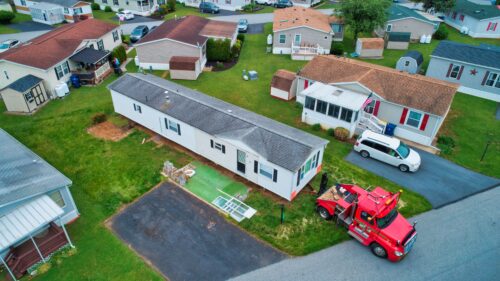
A newly enacted major federal housing law includes measures to spur production of manufactured homes. To deliver real affordability and comfort, federal agencies will need to ensure they are built with good insulation, air sealing, and heating and cooling systems.
Manufactured homes are a critical source of lower-cost housing, and the wide-ranging, bipartisan housing law includes provisions to bring more of them. By removing a requirement that the homes include a chassis, the legislation enables a wider variety of uses and may lower production costs. The law also expands financing options for purchasers and authorizes grants for resident-owned communities and the replacement of very old homes.
To be truly affordable, these homes need to be built with adequate energy efficiency. Yet because the minimum energy standards in effect are more than three decades old, many brand-new units today are built with minimal insulation and poor air sealing. That leaves residents with very high energy bills and can compromise their safety and comfort.
The new law, known as the 21st Century ROAD to Housing Act, doesn’t set new energy standards, but it does require the Department of Housing and Urban Development (HUD) to finally update them. With more manufactured homes likely on the way, promptly putting new standards in place will be critical to avert another generation of homes with high utility bills.
Many new manufactured homes come with a hidden $475 extra cost each year
Manufactured homes can be built to be energy efficient. Nearly half of the new homes in the last couple of years meet high energy specifications.
Many purchasers, though, are not so fortunate. Residents of inefficient new multi-section homes—ones that just meet the decades-old standards—pay an additional $475 per year in energy costs relative to residents of manufactured homes built to decent standards, the Department of Energy found. The owners and renters of manufactured homes, who face these costs for poor energy efficiency, have a median household income of about $40,000.
Models that are minimally insulated and not well sealed can also experience large temperature swings and increase occupants’ risk of asthma. When the power goes out, or residents cannot afford to run heating or cooling, temperatures can get dangerous quickly.
The manufactured housing industry has stymied new standards for decades
Energy standards for manufactured homes are set federally. The ones manufacturers must build to today were set by HUD in 1994.
When HUD did not make any updates, Congress in 2007 ordered the Department of Energy (DOE) to set new energy standards for the homes by 2011 and to regularly update them to cost-effective levels. The manufactured housing industry opposed DOE’s efforts to set standards. The DOE finally set standards in 2022. But a trade association representing manufacturers sued to block them, and DOE delayed compliance in 2023 and again in 2025, and then said it is working to roll back the standards.
The housing law sets a path for regulators to ensure new manufactured homes are built decently
ROAD to Housing leaves in place DOE’s legal obligation to update energy standards but says standards will not take effect until adopted by HUD. For the first time, it gives deadlines for HUD: the agency must set new energy standards within one year and revise them at least every three years subsequently. That’s a big change for an agency that hasn’t improved its standards in 32 years. And existing law requires that when HUD does update such standards, they must be “designed to ensure the lowest total of construction and operating costs.”
Roughly 100,000 new manufactured homes are built each year, and hopefully more soon. To avoid producing more homes that will be costly to live in for years to come, HUD must implement strong standards promptly. It now has a clear legal obligation to do so and can finally ensure that all manufactured homes are built responsibly, bringing true affordability to residents.