Utilities are increasingly central to expanding equitable EV charging access. Insights from ACEEE’s EV Working Group highlight how targeted utility programs and partnerships with local governments and community groups are reducing charging barriers for renters and low-income households.
Leading utilities are launching innovative programs that aim to make electric vehicles (EVs) an affordable and realistic choice for all communities, providing important models for other utilities interested in supporting the transition to EVs. ACEEE hosts a utility working group that convenes representatives from more than 50 utilities in nearly two dozen states to share strategies for expanding EV access in low- to moderate-income communities. Throughout the group’s 2025 meetings, members highlighted the central role of utilities in expanding charging access for all and the importance of strong partnerships among utilities, cities, and other community leaders.
Utilities play a key role in expanding access to public charging
EVs come with lower maintenance and fueling costs and reduce air pollution. But there are real and perceived barriers that make some consumers hesitant or make EVs unattainable in some communities.
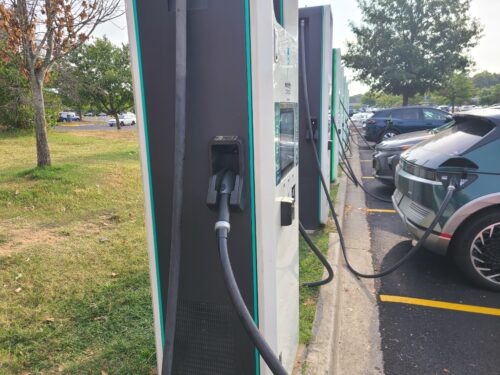
For people who don’t have dedicated off-street parking, including renters in higher-density multifamily buildings, EVs must be charged at publicly accessible charging ports. These public chargers can be both harder to find and substantially more expensive, reducing the cost-saving potential of EV ownership. Our working group has highlighted innovative solutions from utilities to address these barriers, enabling low- and moderate-income households to financially benefit from adopting EVs.
- Preloaded debit cards remove barriers for low-income customers: In Southern California, a group of investor-owned utilities led by Southern California Edison (SCE) plans to launch a new program this year that will directly subsidize EV charging for low-income households. Through this innovative program, SCE will provide qualifying customers with a preloaded debit card to pay for charging at publicly accessible charging stations. The debit cards will be loaded with a benefit of up to $2,600 annually, available in weekly increments and limited to EV charging costs. This could cover roughly 11,000 miles of driving for a program participant, close to the average annual mileage for a typical American driver. Because these chargers are operated by a variety of companies, SCE found that using a generic debit card to subsidize charging helps overcome logistical barriers and ensure EVs are a realistic option for residents across income levels.
- Pole-mounted chargers make EVs more accessible for renters: In Burlington, Vermont, the municipal utility, Burlington Electric Department (BED), recently launched a pilot program for pole-mounted charging. BED installed EV charging equipment on utility poles (which the utility already owns and maintains) to deliver an innovative, cost-effective solution to on-street charging in neighborhoods with high concentrations of rental units that lack access to, off-street parking spaces. BED worked closely with local government partners to coordinate the installation of signage for the new chargers and to prioritize early, proactive engagement with neighborhood residents. Both strategies have made the program a successful model that BED plans to expand into new areas.
- Data-driven insights reveal ways to support delivery drivers who use EVs: In Orlando, Florida, the municipal utility, Orlando Utilities Commission (OUC), has set up a data analytics dashboard that reveals charging usage patterns and highlights opportunities to expand charging access in new neighborhoods. With insights from the dashboard, OUC can make informed investments, like responding to needs from delivery and rideshare drivers. This emerging EV user segment is sensitive to costly charging rates and often lacks access to at-home charging.
- Early utility engagement with affordable housing developers makes EV charging feasible in new construction projects: Utilities can proactively support the installation of EV charging equipment for multifamily buildings by providing clear, accessible guidance to property developers early in the process. Since developers do not always understand the impacts of charging infrastructure on long-term building operations, utilities can provide valuable insights on rate management, charger access policies, and maintenance considerations.
Impactful utility EV programs are built on strong partnerships
By collaborating with city governments, proactively communicating with private-sector developers, or tapping into networks of community volunteers and nonprofits, utilities can make meaningful strides toward expanding access to EVs.
- Coordinated governance makes community outreach more effective: In Seattle, the municipal utility, Seattle City Light (SCL), works closely with other city departments to minimize the engagement burden on communities by sharing insights and leveraging government-wide community liaisons. Rather than engage separately, requiring a lot of the community’s time, SCL and other departments coordinate to maximize feedback from fewer engagements. This engagement informs SCL’s planning and electrification programming and influences city-wide climate and electrification strategy.
- Collaboration with city partners expands EV charging and promotes pedestrian safety: In Pittsburgh, Duquesne Light Company is working closely with the city to develop effective curbside charging solutions that gain community buy-in while keeping city sidewalks and streets accessible to all users. The utility also leveraged federal funding to build charging at locations requested by community members and is working with neighboring communities for the second round of funding, deepening regional ties.
- Local champions can magnify the impact of EV programs through community events: Across Tennessee, utilities are benefiting from innovative community outreach strategies led by local volunteer chapters through the statewide Drive Electric Tennessee program. Drive Electric TN has demonstrated that the best conversations about EVs happen at the local level. Utilities can introduce new communities to their programs by working closely with nonprofit partners and community groups through events that create chances for one-on-one conversations about EVs.
Utilities can be key drivers of EV adoption
Given sharply curtailed federal support for EVs, local and regional programs to promote EV adoption will become increasingly crucial in 2026. Utilities can step up to the plate with new investments and targeted programs to support the EV transition. By removing financial and logistical barriers to charging access for renters and by directly collaborating with cities, community groups, and other key stakeholders, utilities can meaningfully expand EV access for all.
ACEEE’s EV working group for utilities welcomes new members who are interested in participating in a peer-to-peer learning environment focused on what utilities can do to promote EV access for all. Reach out to our team to learn more.