This first-of-its-kind map shows where there is a favorable market environment for the uptake of limestone calcined clay cement (LC3) in the United States, based on a range of supply chain, technical, and policy conditions. For example, the map shows which states have companies producing or selling LC3, which have pilot or demonstration projects, and which have supportive policies in place.
LC3 production can be up to 25% less expensive1Karen Scrivener, Anna. Dekeukelaere, Francois Avet, and Laurent Grimmeissen. 2019. Financial Attractiveness of LC3. LC3-Project. https://lc3.ch/wp-content/uploads/2020/10/2019-LC3FinancialAttractiveness-WEB.pdf. and 40% less carbon intensive than the production of portland cement.2LC3 – Limestone Calcined Clay Cement. 2026. https://lc3.ch/. Accelerating adoption is critical because producing cement, the key binding ingredient in concrete, is the source of nearly 8% of global greenhouse gas emissions3Michael Purton. 2024. “4 Ways to Make the Cement Industry More Sustainable.” World Economic Forum, September 13. www.weforum.org/stories/2024/09/cement-production-sustainable-concrete-co2-emissions/. and lowering costs will enhance U.S. competitiveness.
Produced by increasing the share of calcined clay in cement, LC3 reduces greenhouse gas emissions in two ways. First, it enables greater material efficiency because clays can be combined with limestone to produce blended cement or can be used as a supplementary cementitious material instead of portland cement in concrete.4Pavitra Srinivasan and Neal Elliott. 2022. “Low-Carbon Cement Could Be Sped to Market with Climate Law Funds.” ACEEE. December 23, 2022. www.aceee.org/blog-post/2022/12/low-carbon-cement-could-be-sped-market-climate-law-funds. Second, it saves energy and therefore money. The calcination of clays requires a temperature of about 800°C, far below the 2,000°C required for limestone.5Pavitra Srinivasan and Nora Wang Esram. 2023. “Electrification Is Key to Decarbonizing Concrete. US Investments Should Open the Path.” ACEEE. June 20, 2023. www.aceee.org/blog-post/2023/06/electrification-key-decarbonizing-concrete-us-investments-should-open-path. In addition to reducing fuel use, this creates the opportunity for facilities to switch to heating equipment powered by electricity instead of fossil fuels.
Conditions included in the LC3 adoption potential map
The supply chain, technical, and policy conditions that we mapped are as follows. Together, these conditions create a favorable market environment for LC3 uptake.
| SUPPLY CHAIN CONDITIONS | TECHNICAL CONDITIONS | POLICY CONDITIONS |
|---|---|---|
| Raw material availability | Evaluation by state DOT | Supportive policy |
| Product availability | Specifications by state DOT | Financial incentives |
| Skilled workforce | Pilot or demonstration projects |
We assigned a status and score—1, 0.5, or 0—to each condition in all 50 states. A full point was assigned to a condition in a state where we could verify the presence of the condition, while zero points were awarded if a condition could not be verified. A half-point was given if the state is making progress toward achieving the condition, such as proposing but not yet implementing a supportive policy. Sources for each score can be viewed by selecting the relevant condition in the map and then clicking on the state.
A state’s overall LC3 adoption potential is the sum of the unweighted score of the eight conditions. Likewise, supply chain, technical, and policy category scores are the sums of the unweighted values of their component elements.
Future map updates and additional research
We will continue to update the map based on market changes. Please contact Emma De Leon edeleon@aceee.org or Pavitra Srinivasan psrinivasan@aceee.org with updates, corrections, and other information or news related to any supply chain, technical, or policy conditions impacting LC3 adoption in your state.
To learn more about LC3, see ACEEE’s 2024 report describing the potential emissions savings in each state and showcasing examples of the production and use of this material. To learn more about how ACEEE assesses new and emerging industrial technologies’ potential for uptake based on key technological, market, and financial factors, see our evaluation framework.
As a next step, we will evaluate why LC3 uptake is making more progress in certain states and regions relative to others. We will examine barriers to expanding the use of LC3 and strategies to overcome them.
Authors



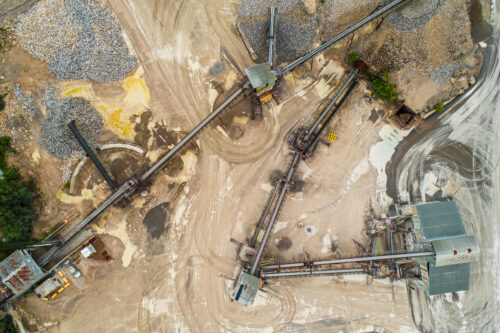
Photo credit to Aaron Yoder, 2021. An aggregate quarry in the Ohio River Valley. LC3 is mixed with aggregate and water to produce low-carbon concrete.

Support the Work That Makes Energy Go Further
ACEEE’s independent research and advocacy depend on the support of foundations, businesses, and individuals committed to cutting energy bills, waste, and climate pollution.