ACEEE’s Leading with Equity Initiative: Year Two Recap and Next Steps
The Leading with Equity initiative’s new memo highlights our work in 2022 and our plans for 2023.

Too many Americans struggle to pay energy bills because they live in inefficient buildings while also facing rising transportation costs and inadequate transit options. Many low-income communities and communities of color lack easy access to comprehensive programs and services from their utilities, states, or cities. These historically under-resourced communities are often excluded from energy planning and decision making, which perpetuates the cycle of exclusion, underinvestment, and inequitable clean energy policy and program outcomes.
“Energy equity recognizes the historical and cumulative burdens of the energy system borne by frontline and low-income communities and by Black, Brown and Native people in particular. To eliminate these disparities, energy equity centers the voices of frontline communities in energy planning and decision-making and ensures the fair distribution of clean energy benefits and ownership.” (Energy Equity Project 2022)
In defining energy equity, ACEEE uses the four dimensions of equity outlined in the 2014 Equity in Sustainability report by Angela Park and her colleagues at the Urban Sustainability Directors Network. These categories are procedural, structural, distributional, and transgenerational equity. Significant change is necessary in all four categories to achieve an equitable energy future.
For over 17 years, ACEEE scorecards and other progress reports have helped benchmark and drive clean energy action by states, localities, and utilities. They identify best practices and set a high bar for clean energy leaders. In 2021, with support from the Barr Foundation, the Kresge Foundation, and The JPB Foundation and in collaboration with Kinetic Communities Consulting and AEClinic, ACEEE launched our Leading with Equity initiative to ensure that our scorecards aren’t just evaluating the energy efficiency actions taken by states, localities, and utilities but also whether these actions are equitable, from their development to their outcomes. Metrics that capture progress toward equity-centered clean energy policy and program outcomes can enable communities to generate the data needed to benchmark progress, hold leaders accountable, and drive more equitable decarbonization for all.
In 2021, the first year of this project, we convened community-based organizations (CBOs), advocates, and utilities to define success for equitable decarbonization, identify barriers to accessing equity-related data, and prioritize equity-focused metrics for inclusion in ACEEE’s scorecards. To learn more about those workshop conversations and the equity-related metrics identified through the process, check out the key findings from the first year of our initiative.
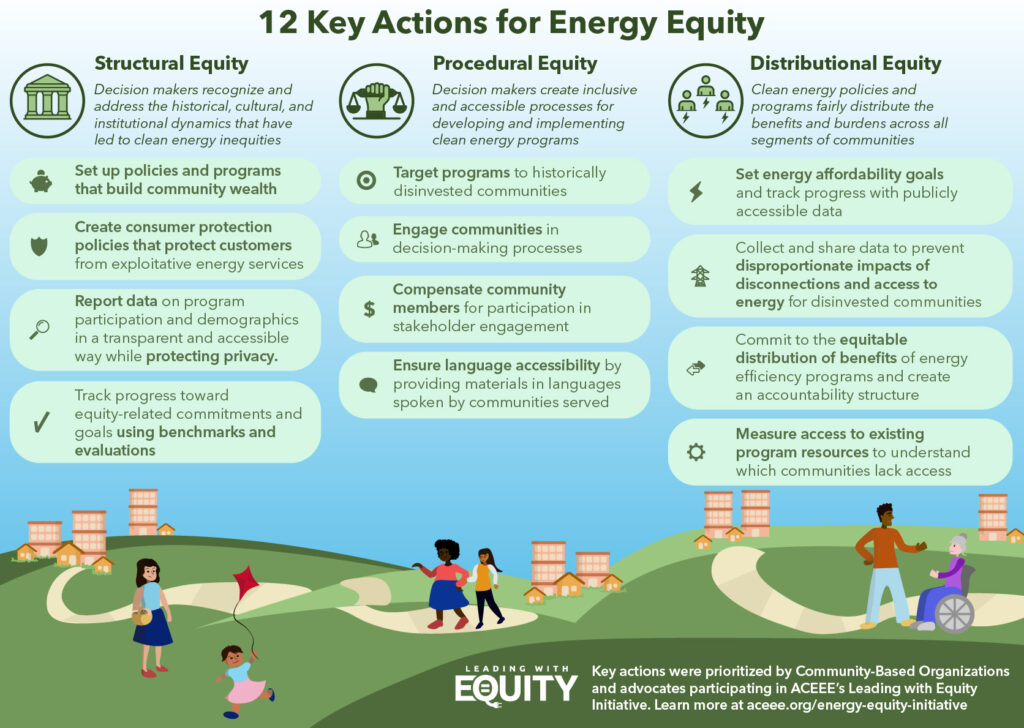
CBOs and advocates identified 12 key actions to advance energy equity, shown in the figure below.
In 2022, ACEEE convened three workshops with a cohort of CBOs and advocates focused on reviewing new scorecard metrics, developing recommendations for state governments, regulators, and utilities, and identifying energy efficiency actions that support the building of community wealth. To learn more about those workshop conversations, check out the summary of the second year of the initiative. ACEEE also published the 2022 State Scorecard, our first scorecard since the start of the Leading with Equity initiative and the first to include recommendations from the initiative. We met our goal of increasing the percentage of equity-related metrics from 4% in the 2020 edition to over 20% in 2022.

Interested in learning more about our equity metrics efforts and/or want to share your own recommendations around improving and expanding equity metrics for city, state, and utility decarbonization? Please fill out this form to be kept up to date on the initiative and ways to be involved.
We are continuing to implement more and better equity-related metrics in our upcoming scorecards. The next Utility Scorecard will be published in summer 2023, and the City Scorecard will follow in early 2024. Both will include improved and new equity-focused metrics. We continue to seek input from community-based organizations and the broader clean energy community to ensure that our new metrics lead to more equitable policy and program outcomes.
As we continue working to better address and center equity in ACEEE scorecards and other research, we will be implementing a more robust process for CBOs to directly review and comment on ACEEE scorecards, including appropriately compensating CBOs for their expertise and time.
We also plan to create resources, including one-pagers accompanying scorecards, that highlight equity-related trends or case studies.

ACEEE is committed to ensuring that the priorities of community-based organizations are integrated into our upcoming scorecards through a transparent and collaborative process. Adapted from the Sierra Club’s Shared Accountability Framework, which was developed in partnership with community-based organizations in Miami, we are committed to the following pillars of accountability:
In addition to holding workshops to refine next steps on equity metrics, partners explored research on how to evaluate programs through the lens of equity impacts. The following white paper provides more information:
The Leading with Equity initiative’s new memo highlights our work in 2022 and our plans for 2023.
New guidance for state agencies, utilities, regulators, and other decision makers to advance more equitable outcomes
These three strategy documents describe how ACEEE’s state, utility, and city scorecard teams are implementing recommendations from our Leading with Equity Initiative. The initiative aims to ensure …
This white paper highlights the key findings from the first year of ACEEE’s Leading with Equity Initiative, launched in February 2021. Through the initiative, ACEEE held two sets of three workshops…
ACEEE’s independent research and advocacy depend on the support of foundations, businesses, and individuals committed to cutting energy bills, waste, and climate pollution.