Residential building energy use (not including residential transportation) contributes to approximately 20% of total U.S. greenhouse gas (GHG) emissions (Goldstein, Gounaridis, and Newell 2020), making it a key sector to decarbonize. When electricity is generated from carbon-free sources, electrification—that is, the process of replacing technologies or systems that use fossil fuels with electricity-powered equivalents—is a critical step in reducing GHG emissions and mitigating climate change (Cleary 2022). Electrifying most U.S. residential and commercial buildings by 2050 could abate 306 million metric tons (MMT) of CO2 emissions (Mai et al. 2018). This would be the equivalent of cutting emissions in these sectors by approximately 50%. To achieve these major emissions reductions, it is essential to first identify current perceptions, interests, and potential barriers for adopting electrification technologies. Structural barriers should be addressed with large-scale policies and programs, while psychological or social barriers should be addressed with behavioral science-based approaches.
We surveyed a nationally representative sample of 1,801 American adults, including renters and homeowners, to understand household behaviors and preferences related to home energy use.[1] This report shares our survey results and demonstrates how utilities, program administrators, and implementers can use behavioral science to more effectively market and promote residential electrification.
Target Consumers Who Are Likely to Switch
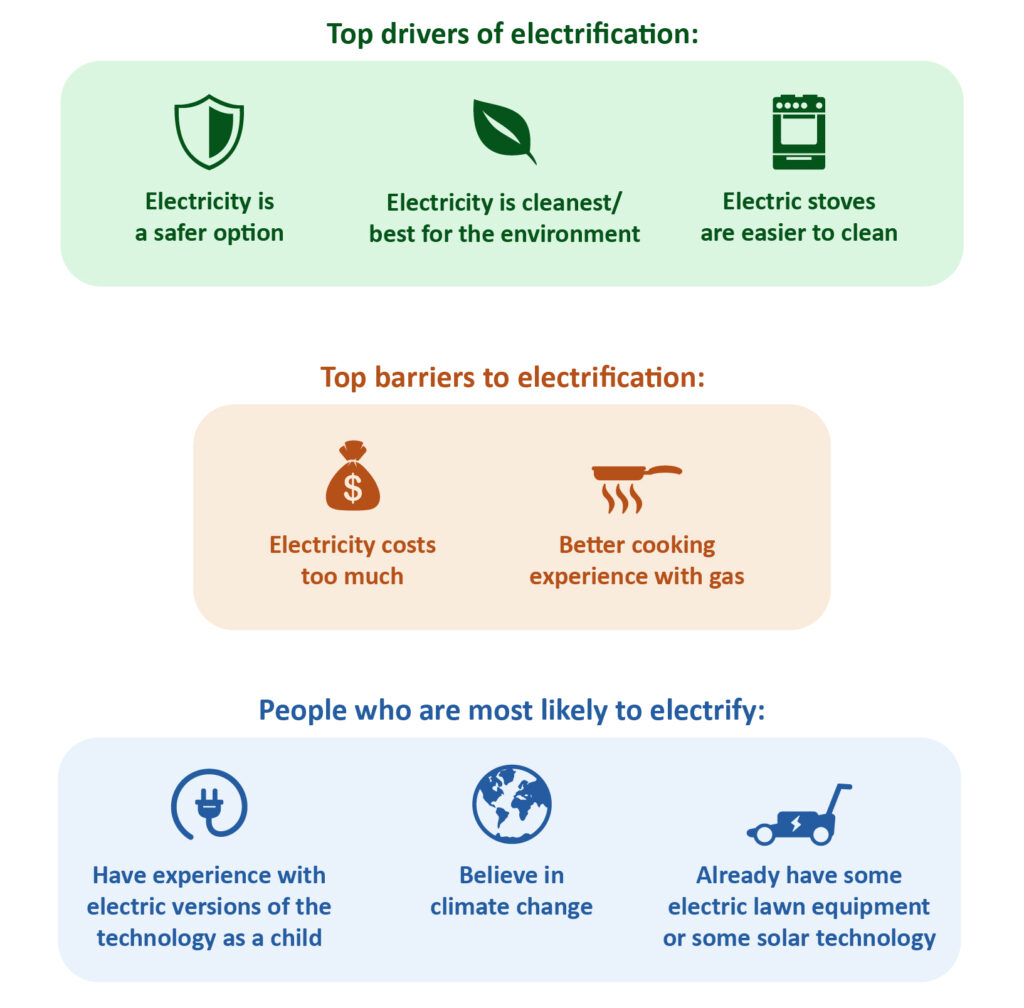
The most significant driving factors for wanting to switch from nonelectric to electric end uses (heat, hot water, and cooking) were childhood experience with the electric appliance or heating/cooling system and belief in climate change. Consumers with these beliefs and experiences tend to vote Democratic, live in apartment buildings or duplexes,[2] be in younger age groups, and have lived in their homes for less than 10 years. For replacing central air-conditioning with a heat pump, belief in climate change and living in a newer home were also important influences. Consumers in these demographics could be good targets for electrification marketing campaigns.
Notably, belief in climate change may be associated with choosing to electrify, but this is not necessarily because electrification is perceived as a climate solution. Indeed, follow-up questions suggest that the connection between electrification and climate change mitigation is tenuous for many Americans. In contrast, nonbelief in climate change is a proxy for a set of underlying values, beliefs, and worldviews that likely affect both perceptions of electrification and of climate change. Therefore, for consumers motivated by climate change—such as those along the coasts or in urban regions—messages emphasizing electrification as a climate solution could be effective for promoting electrification. For other consumers (including the average American in our survey), environmental messages might not be the most effective.
Focus Messaging on Electrification’s Perceived Benefits
Many consumers who were not currently using electricity for each of the three end uses (heat, hot water, or cooking) said that they would choose to switch to electric if their systems broke. These participants cited the environment, health, safety, reliability, and perceptions of energy efficiency as the main reasons for doing so. Cooking was unique in that the second most common reason for choosing to switch to electricity was that electric stovetops are easier to clean (behind environmental reasons). Focusing marketing efforts on these benefits could be helpful for encouraging electrification decisions.
Address Perceived and Actual Barriers
Electricity cost—including the perception that a new electric system is more expensive to operate than a nonelectric version—was the most frequently cited barrier to electrifying home and hot-water heating (and second most cited barrier for cooking). Interestingly, despite efficiency often being perceived as a major benefit of electrification, electricity’s perceived inefficiency (relative to other fuels such as natural gas) was often cited as a barrier as well.[3] For cooking, respondents preferred gas over electric predominantly because they perceived gas stoves as offering a better cooking experience than electric options. However, most respondents were probably thinking of electric resistance rather than induction stovetops, which they may not have previously used. The induction cooking experience is different, and arguably better, than traditional radiant electric cooking in terms of precision, speed, reduced heat loss, and ease of cleaning.[4]
These three perceptions (high cost, inefficiency, and inferior cooking experience) are often based on outdated information. For example, today’s electric heat pumps are more efficient than traditional electric resistance heaters, and electric induction stovetops often provide a better cooking experience than older radiant electric versions. Although large-scale structural, policy, and programmatic solutions are needed to reduce the costs of electricity and high-end efficient electrification measures, attempts to correct misperceptions about electrification could benefit from the use of behavior-based strategies. For example, creating stronger marketing campaigns that highlight the cooking and health benefits of induction stovetops (alongside other energy-saving benefits) and promoting gateway electrification technologies, such as electric lawn equipment, could help increase interest and adoption rates.
Encourage Electrification through Gateway Technologies
Behavior-based strategies could include direct-experience activities. Our survey found that residents who own gateway electrification technologies are more likely to choose to switch to electricity than those who do not. In this report, we focus on electric lawn equipment and solar technology as possible gateway technologies, but electric vehicle ownership may also be effective. Current programs that provide direct experience include induction-cooktop lending programs and hands-on heat pump training for contractors. Future research should investigate the potential of these and other types of gateway and experience-based (free trial) programs.
Implement Policies That Increase Adoption: Incentives When Something Breaks Can Help
In terms of policy support, respondents preferred tax credits and rebates (“carrot” policies) over mandates and requirements (“stick” policies). Our data also show that offering appliance rebates when an appliance breaks is significantly more effective than doing so when the existing appliance is still working. Democratic voters were significantly more supportive of electrification policies than Independents and Republicans. Low-income respondents showed significantly more support than non-low-income respondents for all polices, except for those based on tax credits.
[1] More research is needed to understand the reason for this apparent contradiction. We suspect it was because respondents considered different types of electric and nonelectric technologies when providing these answers.
[2] More research is needed on perceptions of induction versus radiant electric stovetops and whether these perceptions change after experience with each. Perceptions of the cooking experience with induction can be more positive than with radiant electric stovetops, but barriers (such as not being able to use certain cookware) persist (Lynch 2019).
[3] As Appendix A describes, a third-party panel research company recruited the participants for our survey.