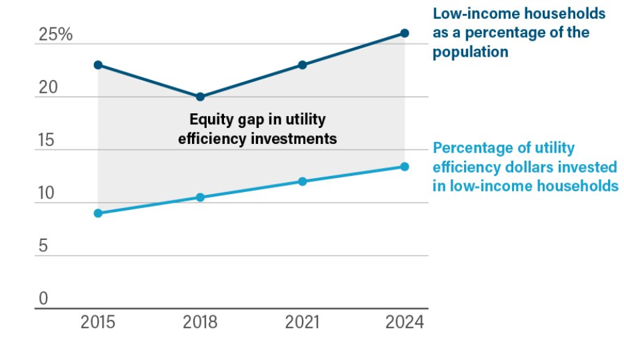
As more Americans struggle with rising energy bills, new research from the American Council for an Energy-Efficient Economy (ACEEE) shows that utility efficiency programs are underserving the households most in need of relief from increased costs. Investments in utility efficiency programs designed to serve low-income households have risen over the last decade, reaching 13.4% of efficiency budgets, up from 9% in 2015, according to the ACEEE report. However, low-income households make up 27.8% of the population, and efficiency programs reach those families at roughly half that rate, leaving an average equity gap of 14.4%.
Read the Report
“Energy efficiency is one of the only tools families have to address rising utility bills, and they need more support to overcome the upfront costs of energy upgrades,” said Anna Johnson, senior state and utility policy manager at ACEEE and lead author of the report. “States and utilities should expand access to efficiency upgrades for the most vulnerable households, ensuring they receive at least a proportionate share of efficiency program investments and benefits.”
Register for the report webinar today at 2pm ET
Efficiency programs provide incentives that cover some or all of the cost of making energy-saving improvements, such as adding insulation or upgrading heating or cooling systems. In states with targets for serving low-income households, efficiency programs provide greater benefits to those most vulnerable to rising energy costs. Those states invest an average of $49.74 annually per low-income customer, more than double the $18.86 average in states without such requirements, according to the report.
The report identifies several common barriers to efficiency investments in low-income households. In some states, rules used to evaluate utility proposals favor programs that require participants to cover part of the cost, putting energy upgrades out of reach for many. Low-income households are more likely to live in multifamily buildings, rental housing, and manufactured homes, but efficiency programs often focus on owner-occupied single-family homes.
The research finds that utility efficiency programs are more likely to reach the households most in need of energy upgrades in states with dedicated funding for low-income households and energy savings targets for those households. The report recommends that legislators or utility regulators take the following actions:
- Set ambitious energy savings targets;
- Require utilities to dedicate efficiency funding specifically to low-income customers;
- Develop programs tailored to the unique needs of multifamily buildings, rental housing, and manufactured homes;
- Pair efficiency upgrades with bill assistance; and
- Combine utility incentives with state, federal, and other financing and incentive programs.
“States have an opportunity to harness energy efficiency to bring energy affordability to those who most need it,” said Forest Bradley-Wright, co-author of the report and ACEEE’s state and utility policy director. “When utility efficiency programs are directed to serve low-income households, they design programs around the needs of those households rather than taking a one-size-fits-all approach.”
The study is based on analysis of 2024 data (the most recent available) from 53 large utilities that together account for 58% of U.S. electricity sales.