Who Will Use the Proposed Framework?
|
(1) investors who want to understand their return on investment in start-ups as products commercialize. |
(2) novel technology manufacturers, who need to understand marketplace needs and develop information to help end users choose the right product. |
(3) policymakers. |
(4) public and private procurement officials who need to evaluate selections on a consistent basis, especially for infrastructure and other large projects. |


Additionally, the architectural and engineering (A&E) communities, who may be considering the use of new or emerging technologies in projects, may find it useful to better understand these technologies.
Why Do We Need a Building Technology Evaluation Framework?
Over the past 5-10 years there has been an explosion of new and emerging building material technologies and products that have been funded, rapidly developed, and introduced in the construction market. Energy use and emissions are associated with the manufacture of building products, and the construction process itself. Reductions in energy and emissions may occur during raw material extraction, manufacturing, transportation, and installation; they also occur during product use stages and end-of-life disposal or recycling (see our embodied carbon landing page for more information). Innovative technologies emerge from university research and national labs, startup companies, and established manufacturing companies’ research and development (R&D) departments. Technologies in earlier R&D stages are referred to as “emerging,” with those in later deployment stages called “new” given their limited use in the market. Collectively, these technologies utilize a wide range of strategies to improve material, energy, product, and process efficiency, including using alternate raw materials, alternate process heat, additive i.e., strengthening materials, and other approaches (DC2 2024).
The uptake of new and emerging building technologies has been slow for several reasons, including:
- lack of understanding and measurement of their efficiency potential, and in some cases, market/end-users’ inability to fully understand actual performance and savings in real-world field applications;
- lack of cost parity with traditional products;
- lack of distribution channels (e.g., for concrete, through ready mix companies);
- limited understanding of how to use new products and of how they meet construction and building codes and standards; or
- inadequate or incomplete product technical specifications and questions about their scalability, longer-term durability, performance, and optimal use applications (NETL 2023), leading to risk aversion to using new products in a traditional industry.
These barriers to adoption lead builders to default to previously used, known options, especially in the context of tight construction schedules and budgets.
Both public procurement and private investors are looking for opportunities to improve construction cost-effectiveness, efficiency, and timelines—innovative technologies could help achieve all of the above. Thus, all stakeholders who influence building design, construction, and material use need to better understand these new products, their use cases, and what constitutes improvements in the construction process.
Currently, environmental product declarations (EPDs)—standardized reporting labels—are used to communicate a product’s environmental impact using data from a lifecycle assessment or LCA (ISO 2006a, 2006b, 2006c—see Background) which could be used to inform the expected energy use and efficiency gains from a material or product, However, newer, more innovative materials and technologies lack EPDs because one full production year of data is required; this data can only be gathered if there’s sufficient market demand for the material or technology in the first place. Furthermore, LCAs alone might not capture the definitive emission intensities or savings provided by products that use multiple materials in various quantities. Finally, there is no consistent framework for the market to assess and compare the wide range of innovative technologies across a consistent set of parameters.
Most industry trade associations and standards organizations also do not want to be perceived as choosing between new and emerging technologies or disrupting the use of traditional technologies currently dominating the market without commercially available and viable alternatives (e.g., newer options that comply with existing specifications and standards or are available at scale).
Solution to the Problem: Evaluation Framework
We propose an evaluation framework with specific criteria to assess new and emerging building technologies across a range of characteristics (see Background for more information on how we developed this framework). This system includes:
(1) Technological criteria (e.g., manufacturing energy use, emissions reduction potential, technology readiness level (TRL), and material or product technical parameters related to performance—strength and durability);
(2) Market criteria (e.g., market size, product scalability, application type, value proposition, market or product differentiation); and
(3) Financial criteria (e.g., cost of novel technology implementation compared to business-as-usual or BAU).
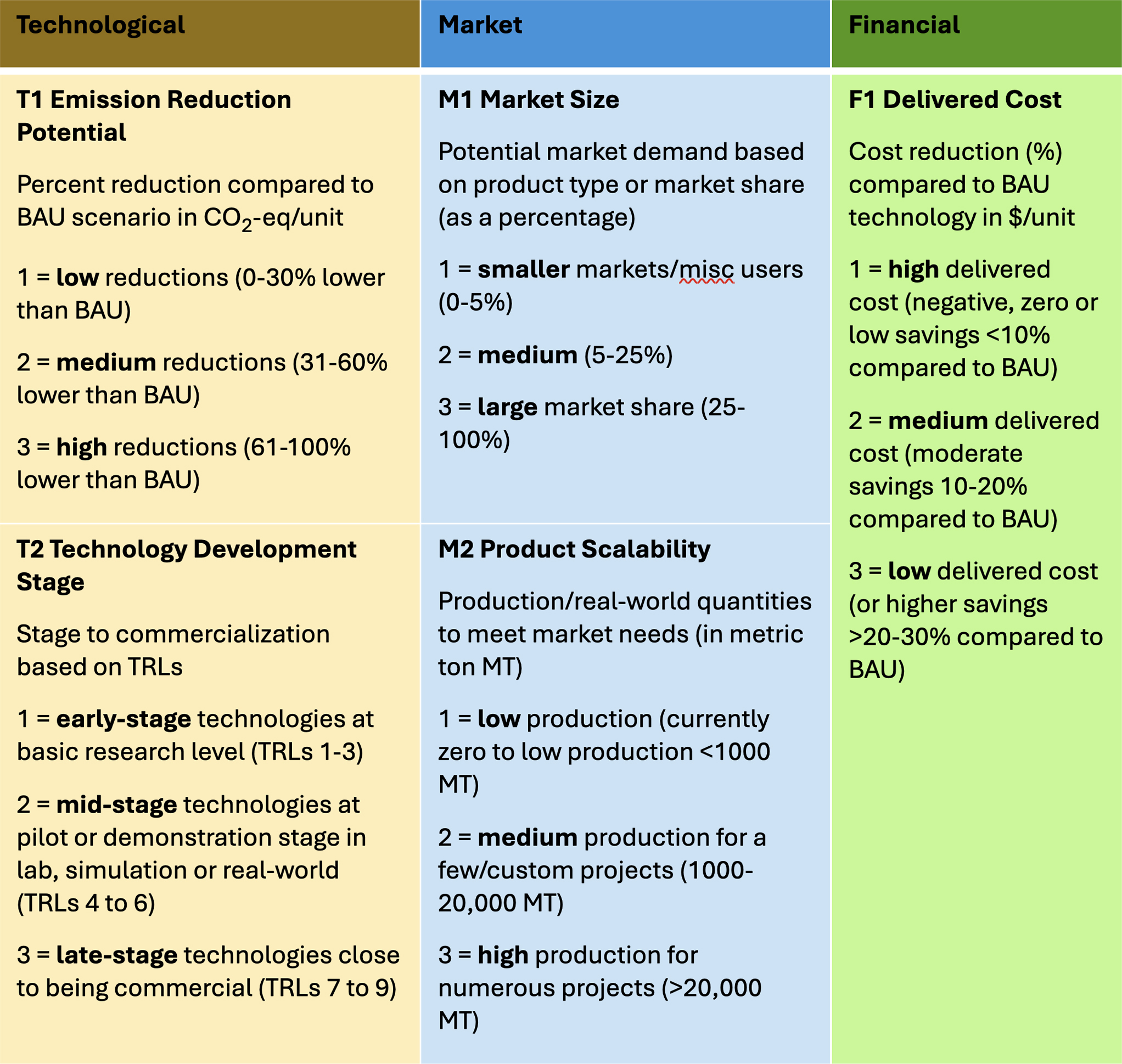
Within the suite of available criteria we focus on a select list of key or primary ones under each assessment category, as “threshold” or “must have” elements that need to be evaluated for all new and emerging technologies (see table 1). A particular technology may score well across multiple criteria but be missing one or more of these critical elements, without which it will fail to progress in the marketplace. We use pre-defined, three-point scales to assess criteria, using an equal weighting approach. Users of this framework can adjust the criteria weighting factors based on their needs. For example, procurement officials may prioritize financial criteria, R&D funders may prioritize emissions reduction potential and the technology development stage, while investors may focus more on the market size and product scalability. Additionally, secondary and tertiary evaluation criteria may be developed for specific materials or products to assess other attributes (e.g., material performance characteristics like strength or durability) based on priorityneeds to further expand the framework.
Table 1. Framework primary* evaluation criteria.
Explanation of Technological Criteria, Market Criteria, Financial Criteria
Evaluation and Scoring Approach
The scores across each evaluation category are combined to form a total score, revealing technological viability (based on currently available information) on a sliding scale from 1 to 15 where scores of 1-5 correspond to the lower end of the viability scale, 6-10 correspond to a mid-range viability, and 11-15 correspond to the higher end of the viability scale. Additionally, this evaluation only presents a snapshot of the current technology and investment landscape, which is anticipated to evolve over time. To illustrate how the criteria are applied, see our concrete technologies heat map and case studies.
The most promising technologies would offer great lifecycle savings at high TRLs with strong market characteristics at lower or equivalent cost to BAU. However, in some instances, an innovative material or product may only be available in smaller quantities (especially in lower TRLs) for use in limited applications within a given project despite excellent technical attributes. Thus, the architect or designer would need to decide how to use the innovative material or product while meeting their project’s cost-benefit requirements.
Evaluation Framework Applied to New and Emerging Concrete Technologies
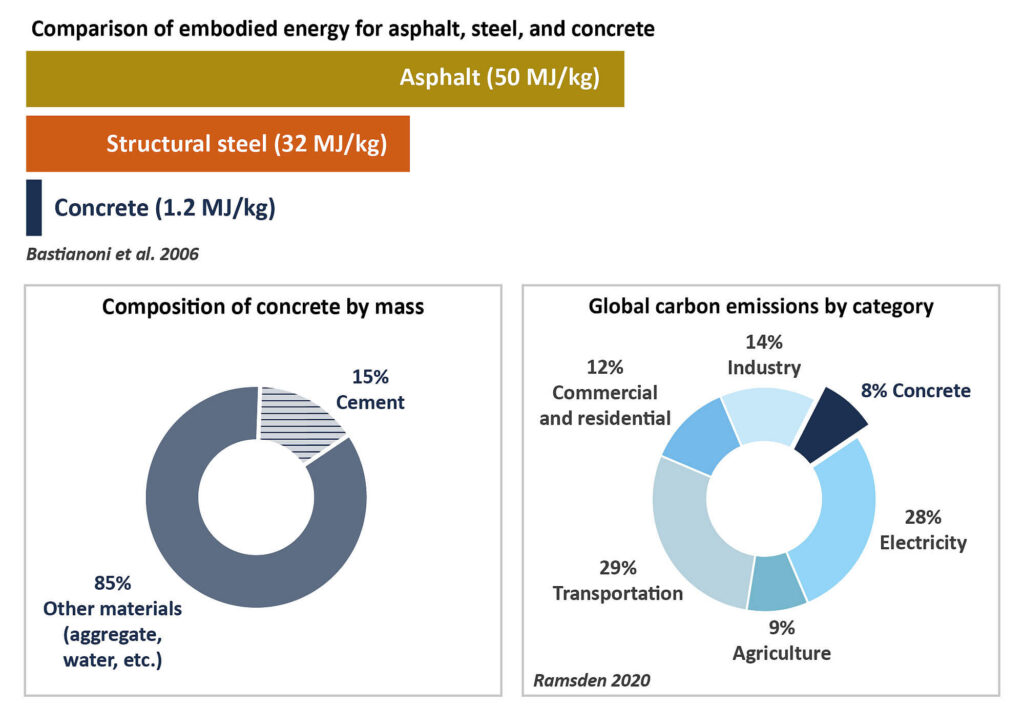
Concrete by itself has relatively low embodied energy (1.2 MJ/kg) compared to structural steel (32 MJ/kg) and asphalt (50 MJ/kg) (Bastianoni et al. 2006), with most of its emissions arising from the approximately 15% of cement (by mass) used as the binding agent in a concrete mix (see figure 1). It is the large quantity of concrete used in construction that can provide an opportunity for savings from material or process efficiency.
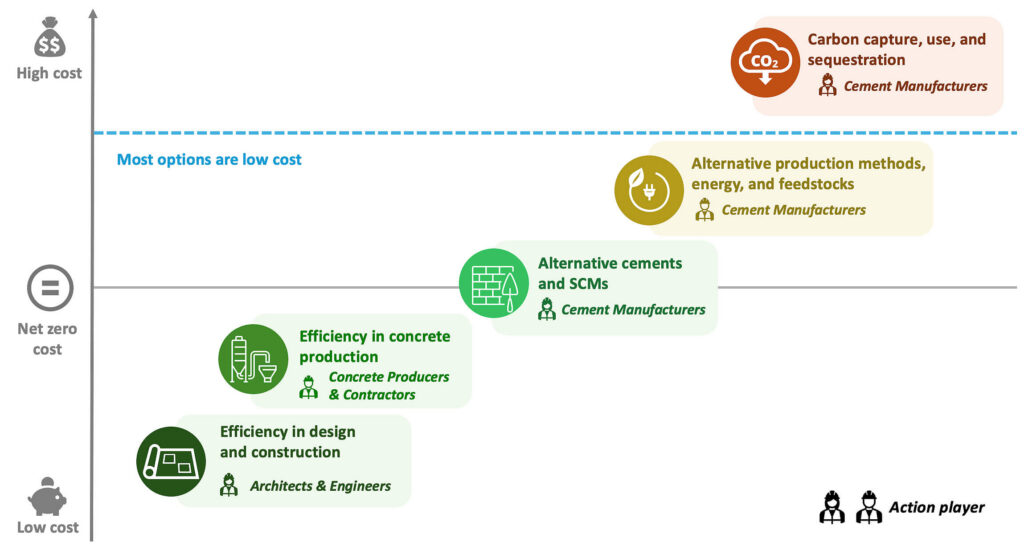
Thus, efficiency strategies for concrete need to consider all lifecycle stages, contributing components, and the whole value chain. Figure 2 summarizes the five main strategies that three different groups of stakeholders could use to improve construction efficiency from concrete, with descriptions below. There are over 100 new and emerging technology companies in operation globally that employ one or more of the below measures, about 70 of which have products or technology solutions available in the U.S. (personal communication, NEU 2025). A combined approach has the potential to drastically improve concrete products and requires collaboration among different value chain players.
Concrete Technologies Heat Map and Rating Score
Table 2 represents a heat map evaluating a variety of new and emerging concrete building technologies at this point in time, using our proposed primary or threshold criteria that are equally weighted. The evaluation criteria applied to concrete technologies follow the scoring as in table 1. [Note: M1 Market Size is specifically assigned based on concrete product type: 1 = smaller markets, other/miscellaneous users (0-5% of the market); 2 = medium (5-25% of market) i.e., concrete products such as precast, pre-stressed, reinforced concrete, etc. making up 11% of U.S. market; and 3 = large (>25% of market) i.e., ready mix concrete which makes up 70-75% of U.S. market]. BAU comparison refers to concrete made with portland cement and processes associated with its production and/or use.
This table illustrates our methodology with a screening evaluation and is not meant to compare technologies; a full evaluation will require additional information from technology developers or vendors. Organizations such as NEU are compiling a comprehensive list of new and emerging technologies available in the market.
Below the heat map, we present brief case studies of strong candidate technologies to show how they meet our evaluation criteria.
Table 2. Heat map and score evaluating new and emerging concrete building technologies
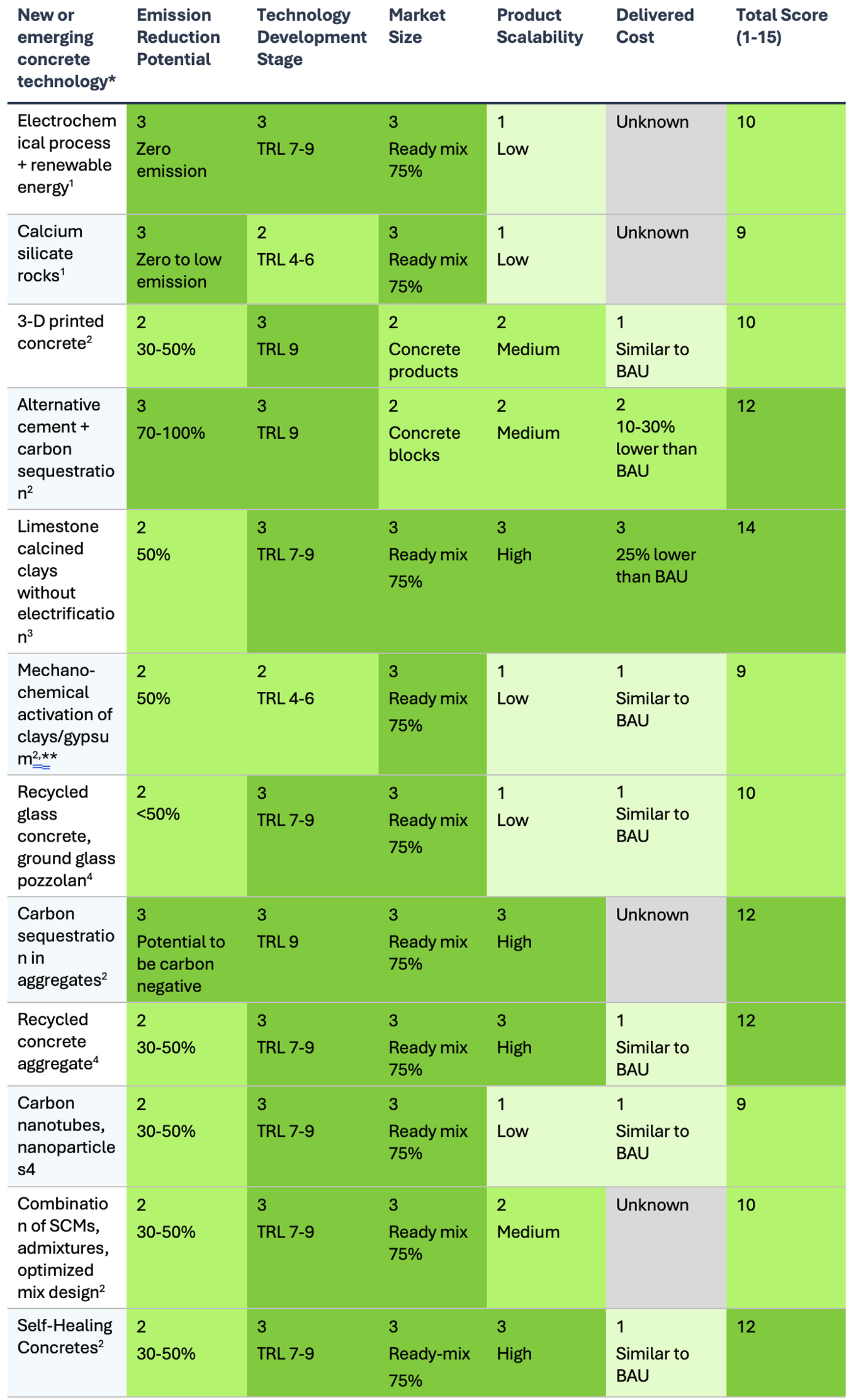
*Unknown refers to current lack of publicly available information on company website. Last updated: February 28, 2026.
**Also a lab technology. Source: personal communication, national laboratory 2023.
Superscript numbers indicate the number of companies whose information was used to evaluate the score which used the median across the available information.
Contact Pavitra Srinivasan or Fikayo Omotesho to add or update your technology’s score on the heatmap.
Case Studies
International Technologies
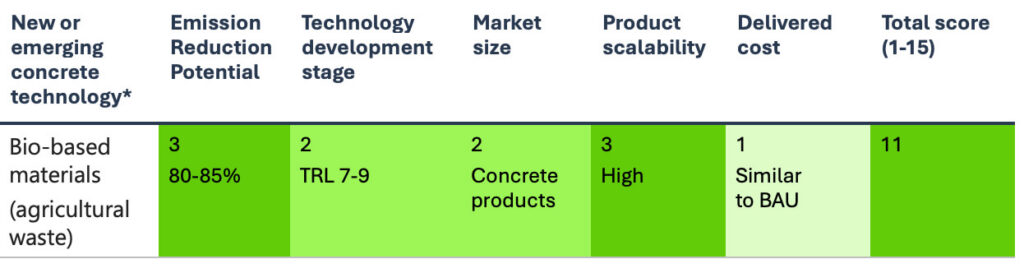
Innovation in low-embodied-carbon cement and concrete is a global effort, with breakthrough technologies emerging internationally that offer important lessons and pathways for domestic decarbonization efforts. This section highlightsother countries’ technologies and approaches in building processes that demonstrate strong potential to lower emissions and increase efficiency. The heat map for international technologies applies the same five primary or “threshold” criteria seen in Table 1 Framework primary evaluation criteria [jumplink] —energy and emissions reduction potential, technology development stage, market size, product scalability, and delivered cost—using the same three-point assessment scales. Tracking these international developments is valuable for identifying where potential exists for emissions reductions globally and where policy, procurement, and investment support by the US and other countries can accelerate adoption of solutions and promote decarbonization of the built environment.
Table 3. Heat map and score evaluating international new and emerging concrete building technologies
Biobased Materials
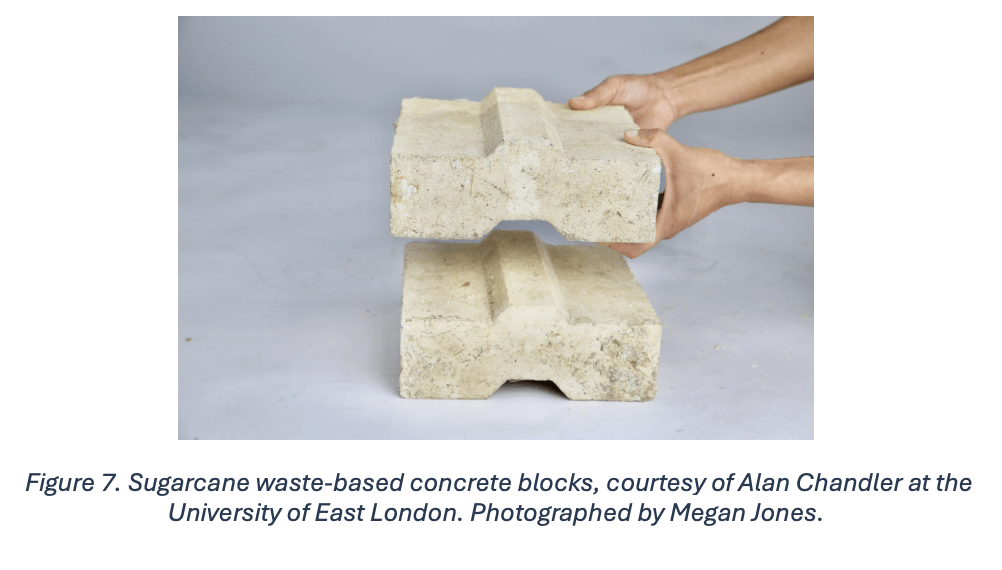
Bio-based materials such as wood, straw, and bamboo are renewable biological resources that serve as sustainable alternatives for construction. Low-carbon, bio-based construction materials can be developed from agricultural byproducts as well. For example, sugarcane is the most cultivated crop globally, and 30% of sugarcane harvested annually is wasted. The University of East London (UEL) in collaboration with Grimshaw Architects and Tate & Lyle Sugars has developed aproduct that upcycles bagasse, a waste product of sugarcane production, by combining it with mineral binders and compressing it into interlocking blocks (UEL 2025). The production process resembles conventional concrete block manufacturing, but it is substantially less energy-intensive, requires no high-temperature kiln firing, and curing occurs in as little as one week whereas standard concrete requires 28 days (Grimshaw 2023). The blocks can serve a variety of building construction needs such as insulation panels, flooring, and load-bearing blocks. The material has passed industry standards for compressive strength, fire resistance, thermal conductivity, and durability (UEL 2025). Biobased technologies offer high carbon reduction potential, up to 80-85% lower emissions than traditional concrete (UEL 2023). Given their mid-stage development, these technologies are also ready for pilots and demonstration projects. Scalability is a key strength given the abundance of agricultural by-products like bagasse, but proximity to the feedstock is an important consideration, so it shows strong potential to meet demand in local markets. Financially, cost information is currently unknown for many biobased materials. However, a material made from bagasse with a delivered cost that is 20-30% higher than BAU, has the potential to offset other construction costs due to reduced mortar use or even longer-term operational energy costs due to better insulative properties. In 2025, UEL partnered with Chemical Systems Technologies to build an entire classroom wing at Panchsheel Balak Inter College in Noida, India (UEL March 2025)demonstrating the feasibility of real-world construction with bio-based building solutions. This material is primarily available in India and Brazil.
Commercialization requires both market supply and demand
Wide-scale technology adoption and commercialization require actions across the market spectrum from supply to demand. We can take the concrete market as an example. For more information, please download the Implementation and Commercialization Strategy factsheet.
| On the supply side, since production of concrete is largely a local enterprise, new technology adoption in this sector requires product manufacturing facilities to be established within local geographies. This requires establishing new plants or retrofitting old ones, training and perhaps reskilling plant employees, and developing technical assistance teams and educational materials locally. | On the demand side, the new products or technology would need to be used in construction projects. In the concrete industry, if the innovative technology works in ready mix for example, there will need to be sufficient plant infrastructure built out so that any project looking to use the material could obtain adequate supply. For precast concrete, the end product may be shipped longer distances but increasing distances adds to project budgets, timelines and fuel consumption from transportation. |
Acknowledgements
This website was made possible through the generous support of Breakthrough Energy, Conscience Bay, Energy Innovation, and Blue Horizon. The authors gratefully acknowledge external reviewers, internal reviewers, colleagues, and sponsors who supported this project. External expert reviewers included Sureka Sumanasooriya from the American Concrete Institute NEU and Reshma Singh from Lawrence Berkeley National Laboratory. We also received support and advice from Simon Brandler of Brimstone, Daniel Duque of Cementos Argos, Don Ajamian of Emergent, Jacob Kumpon of KLAW, Alan Chandler of the University of East London, and Erin Glabets of Sublime. Internal reviewers included Steve Nadel, Richard Hart, and Nora Esram. External review and support do not imply affiliation or endorsement. Lastly, we would like to thank Mariel Wolfson for editorial guidance, Kate Doughty for design support, and Ethan Taylor for his help in launching this website.
Resources
Download the Background for the Evaluation Framework
Download the Implementation and Commercialization Strategy
View our evaluation framework presentation slides here (presented at the 2024 Buildings Summer Study): www.aceee.org/proposed-evaluation-framework-new-and-emerging-low-embodied-carbon-concrete

Support the Work That Makes Energy Go Further
ACEEE’s independent research and advocacy depend on the support of foundations, businesses, and individuals committed to cutting energy bills, waste, and climate pollution.