ACEEE | American Council for an Energy-Efficient Economy
Energy Efficiency as a Resource
A foundational principle of utility-sector energy efficiency programs is that the energy they save reduces and offsets the energy otherwise supplied by the electricity grid or natural gas infrastructure. Such saved kWh (electricity) or therms (natural gas) are viable system resources for purposes of utility planning, investment, and operation because energy savings from customer programs can reduce system demand enough to avoid the need for new supply infrastructure, such as generation plants, transmission lines, and distribution system upgrades. Investments in energy efficiency and the resulting resource benefits are factored directly into utility energy resource decision-making about investing in new resources and operating existing systems.
The origin of utility-sector energy efficiency programs dates back to the energy crises in the 1970s, when a new concept of “energy conservation” emerged to help customers cope with soaring energy prices. Over time, this led to the development of an expanded set of customer energy efficiency programs provided by electric and natural gas utilities.
Benefits of Energy Efficiency as a Resource
Energy efficiency has evolved to become recognized as an integral, highly valuable element of utility investments and operations. Utility energy efficiency programs have yielded significant energy and economic benefits to the utility system and to utility customers. Energy efficiency programs have also led to job growth in many fields, including the building trades.
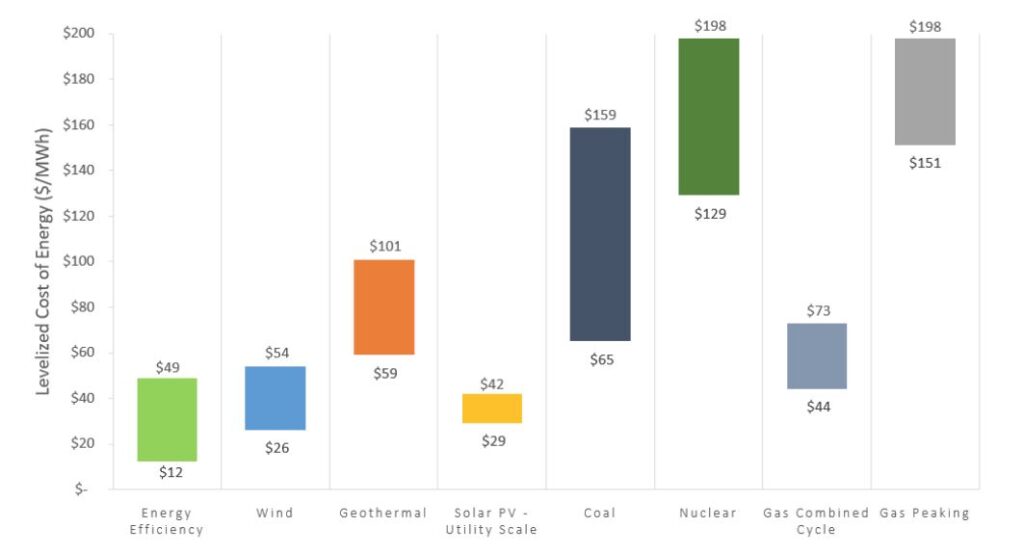
Energy efficiency today is an important utility system resource, typically the lowest-cost system resource compared to supply-side investments. Saving energy via customer energy efficiency programs generally can be achieved at one-third to one-fourth the cost of fossil-fuel based supply-side alternatives.
Levelized cost of energy efficiency compared with unsubsidized supply-side resources (Data: ACEEE 2020, Lazard 2020)
Levelized cost of energy efficiency compared with unsubsidized supply-side resources (Data: ACEEE 2020, Lazard 2020)
Utility-sector energy efficiency programs also yield various other benefits, including greenhouse gas reductions, customer utility bill savings, job creation, and improved air quality.
Supportive Regulations and Policies
State regulators of investor-owned utilities (and their counterparts for publicly owned utilities) play a prominent role in setting regulations that support the establishment and implementation of utility-sector energy efficiency programs. Experience has shown that without very direct and supportive regulations and policies, utilities will not develop and offer significant customer energy efficiency programs.
State policymakers and regulators can provide clear direction to regulated utilities about the importance of energy efficiency by requiring utilities to offer programs and establish supportive business models for these programs. States also can establish specific energy savings targets (typically as a percentage of total energy sales) for regulated utilities. Such energy efficiency resource standards are in place in a large and rapidly growing number of states.
The Greatest Energy Story You Haven’t Heard: How Investing in Energy Efficiency Changed the US Power Sector and Gave Us a Tool to Tackle Climate Change
For decades, energy efficiency has been a critical strategy for meeting US electricity needs while saving consumers billions of dollars in avoided infrastructure costs. Just how big is energy effic…
Everyone Benefits: Practices and Recommendations for Utility System Benefits of Energy Efficiency
This report details the wide range of benefits of energy efficiency to the electric utility system, including traditional avoided cost of energy as well as many other economic benefits. These benef…
The Cost of Saving Electricity for the Largest U.S. Utilities: Ratepayer-Funded Efficiency Programs in 2018
Energy efficiency has historically been one of the lowest-cost resources available to utilities and grid planners to meet their power supply needs. Given the complex interplay of changing technolog…
Three Decades and Counting: A Historical Review and Current Assessment of Electric Utility Energy Efficiency Activity in the States
Providing programs to electric utility customers to reduce their energy use through improved energy efficiency is an innovation with roots in the energy crises of the 1970s. The concept that energy…
Support the Work That Makes Energy Go Further
ACEEE’s independent research and advocacy depend on the support of foundations, businesses, and individuals committed to cutting energy bills, waste, and climate pollution.