This web page is part of a series on how local governments and utilities can collaborate to advance energy efficiency. It describes strategies for partnerships that can lay the groundwork for and increase local participation in utility energy efficiency programs by jointly marketing, implementing, or funding them.[1]
All cities have relationships with their citizens as a result of their core service delivery responsibilities (waste, water, permitting, public safety, etc.) that can provide valuable channels of communication to potential utility program participants. These partnerships range from working together on a specific building or efficiency project to formal arrangements under which local governments administer programs using utility ratepayer funds. With the exception of public power utilities, state-level authorities generally set utility energy efficiency policy. However all local governments can work with their utilities to improve the energy efficiency of their communities. These partnerships can serve the cities themselves by improving the energy efficiency of municipal operations and buildings as well as households, businesses, and industries within the community.
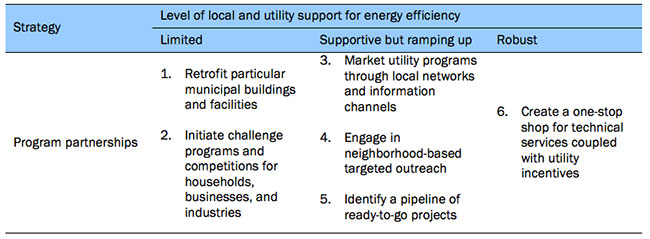
The most effective partnership approach or tactic will depend on the current level of support for energy efficiency at the state level and the types of utility programs currently offered. Table 1 suggests which of the tactics described in this fact sheet might work best in your city based on the level of support for energy efficiency on the part of the state government and utilities. Think of the tactics as options that build on one another. The ones in the first two columns will still be effective in robust energy efficiency states, but some strategies will be most effective when leveraging strong, utility-led energy efficiency programs.
Table 1. Tactics for local government–utility partnerships (based on level of state and utility support)
Tactics
1. Retrofit particular municipal buildings and facilities. Even in states where utilities do not consistently offer energy efficiency programs, local governments can partner with their utilities to target their own large buildings and facilities. Cities can start by tracking energy usage and implementing energy efficiency investments in municipally owned buildings and housing stock such as city halls, civic centers, schools, or public housing. Utilities can provide technical assistance in identifying energy efficiency opportunities and financial incentives. By highlighting the joint effort and providing positive attention for the utility, these public and often highly visible projects can be a catalyst for ongoing collaboration and demonstrate the energy and cost savings that efficiency can deliver.
2. Initiate challenge programs and competitions for households, businesses, and industries. Challenge programs and competitions can also help build relationships between local governments, building owners, and utilities. Challenge programs are voluntary initiatives that motivate residents, businesses, or government agencies to commit to reducing their energy use through prizes or other public recognition. These motivated participants are ideal candidates for existing utility rebate and incentive programs. Challenges can also demonstrate the demand for and benefits of energy efficiency in states where policy support and programs remain limited.
3. Market utility programs through local networks and information channels. To reach a large audience of building owners, developers, and residents, local governments can leverage their building permitting and other real estate networks to inform homeowners, businesses, and builders about energy efficiency incentives they can access through utility programs. Many cities have built networks of residents and businesses as part of their sustainability initiatives. Local governments can help utilities market their programs by tapping into these existing networks while improving awareness of and access to rebates and incentives.
4. Engage in neighborhood-based targeted outreach. Energy savings potential and participation in utility-led programs are unevenly distributed across cities or utility service territories because of differences in building stock as well as the characteristics of decision makers. Community-based approaches to delivering energy efficiency services can target specific neighborhoods or market segments such as multifamily buildings or senior-living facilities. This allows for more direct outreach through canvassing and partnerships with neighborhood and business associations, community groups, and employers. The Better Buildings Neighborhood Program (BBNP), a competitive grant program funded by the American Recovery and Reinvestment Act (ARRA), has supported dozens of local programs testing community-oriented outreach strategies.[2]
5. Identify a pipeline of ready-to-go projects. Cities are well positioned to help utilities identify and recruit potential participants for their programs. In addition to managing their own portfolio of municipal buildings, public housing, and schools, city agencies are connected to developers and building owners through development review, building permitting processes, and housing departments. These points of interaction allow cities to identify projects with large energy savings potential at the point of new construction or redevelopment, a prime opportunity to improve efficiency with little marginal cost. This strategy can be enhanced if utilities provide whole-building energy data and automated benchmarking services.
6. Create a one-stop shop for technical services coupled with utility incentives. Even with generous utility incentives additional barriers prevent homeowners and businesses from investing in energy efficiency. One-stop-shop programs provide individuals with technical support to simplify the process of choosing the right energy efficiency measures, help in finding and hiring contractors to complete the work, and access to upfront incentives as well as financing. These programs often involve public/private partnerships between local governments, community organizations, energy service providers, and utilities. Local governments are uniquely positioned to bring together these partners to deliver locally appropriate energy efficiency services through one easy-to-access channel.
Questions to Consider When Identifying Strategies for Your Community
While current state policies and programs offered by utilities are an important factor to consider, local governments and utilities should ask themselves additional questions to identify opportunities and determine the most appropriate strategies.
For local governments
- How do utility-sponsored energy efficiency programs match up with your community’s goals and priorities? For example, if your city has or is considering an energy benchmarking requirement for commercial or residential buildings, do your utilities offer programs that could help residents and businesses access and act upon new information about their energy use?
- What existing networks and communication channels can you leverage to spread the word about available programs? These channels may include networks built around sustainability or climate action plans, or those related to core city services such as building permitting and real estate transactions. If a homeowner applies for a building permit to renovate their home, are they provided with information about utility incentives that could help improve their house’s energy efficiency at the same time?
- What are the utility’s goals and what challenges can you help them overcome? For example, is your utility having trouble reaching a particular market segment, e.g., low-income customers or small businesses that you may be able to help them reach? Are they ramping up programs for the first time and looking for a pipeline of potential projects?
For utilities and program administrators
- Do the cities in your service territory have energy efficiency or sustainability goals or policies for their own operations or their communities that could help drive awareness of and participation in your programs?
- Are there locally administered energy efficiency programs such as those first funded by the American Recovery and Reinvestment Act that you could partner with?
- Are there any market segments that you have not yet reached with your programs that local governments are well suited to help you access based on the services they deliver such as public buildings and schools, multifamily and affordable housing, hospitals, or small businesses?
- Are there any large developments or public projects on which you could partner with the city to achieve large energy savings and gain positive attention for your programs? These could include retrofits of large public facilities like city halls and civic centers as well as large public–private development projects.
Case Studies
Renew Boston
The city of Boston partners with its energy utilities NSTAR and National Grid as part of the Renew Boston initiative. This effort is designed to strategically leverage utility programs to meet the city’s aggressive energy efficiency and renewable energy goals. The city helps residents, businesses, and institutions save energy by connecting them to energy service providers and utility incentives. The program was initially developed through a comprehensive planning process that involved several city agencies, the utilities, and local stakeholders.
The utilities play a key role in providing the incentives that Renew Boston leverages, and in providing technical support. NSTAR, the electric utility, loans the program one of the utility’s full-time utility program managers. The program manager helps identify and coordinate large energy efficiency projects. Both utilities provide funding to support program’s community outreach activities.
Tactics Used
For more information : http://www.renewboston.org/
Xcel Energy’s Partners in Energy
Xcel Energy created the Partners in Energy program in Minnesota and Colorado to help communities design and implement energy plans that include efficiency and renewable energy strategies. Initially, Xcel provides communities with information on their energy use, program participation, and market segmentation. Community leaders then partner with Xcel to align community and utility programs and initiatives to promote energy efficiency among businesses, residents, and the local government.
Community engagement is an important part of the program. Appearing at local events, Xcel representatives educate residents and businesses about available programs and other community resources. Xcel also lets communities celebrate the success of their programs by helping to track and report the progress of energy efficiency programs. This collaborative effort improves the programs’ delivery and participation rates and helps communities reach their energy goals.
Tactics Used
For more information : http://www.xcelenergy.com/Community/Community_Involvement/Partners_In_Energy_Community_Programs
Retrofit Chicago
The city of Chicago created Retrofit Chicago to provide a central destination for energy efficiency services for commercial, residential, and municipal buildings. The Commercial Buildings Initiative is a voluntary effort among the city’s largest commercial buildings to reduce their energy use by 20% in five years. The Multifamily Home Energy Savings Program is an effort to get owners and occupants of apartment buildings and condominiums to reduce energy and water use by installing free energy- and water-saving measures for interested tenants and owners. ComEd and Peoples Gas, the electric and gas utilities, were involved from the beginning, and along with additional public and private sector partners, provide building owner participants a combination of financial incentives, technical support, and public recognition.
These programs, coupled with the city’s own efforts to save energy in municipal buildings, is helping Chicago meet its Better Buildings Challenge goal of reducing energy use by 20%. ComEd and Peoples Gas, meanwhile, are able to achieve large-scale energy savings to help them meet their policy obligations.
Tactics Used
-
Retrofitted particular municipal buildings and facilities
-
Initiated challenge programs and competitions for households, businesses, and industries
-
Identified a pipeline of ready-to-go projects
-
Created a one-stop shop for technical services coupled with utility incentives
For more information : http://www.cityofchicago.org/city/en/progs/env/retrofit_chicago.html
Baltimore Energy Challenge
The Baltimore Energy Challenge (BEC) is a city-led, grassroots neighborhood and school-based effort to help city residents, businesses, and nonprofits take advantage of low and no-cost ways to save energy. Outreach efforts are supported by AmeriCorps volunteers who attend community, school, and church meetings or meet with small businesses to talk about the program, provide information about utility energy efficiency programs, and ask residents and businesses to commit to reducing their energy use.
In 2013, the program was expanded with utility funding made available by BGE, the local gas and electric utility, as a condition of its merger with Exelon. The funding was authorized by the Maryland Public Service Commission, and will enable BEC to provide free installation of energy- and water-saving measures for Baltimore residents. The community-based outreach approach has enabled BEC to reach residents and small businesses that may not have taken advantage of traditional utility energy efficiency programs, and will help Baltimore reach its goal of reducing energy use city-wide by 15% by 2020.
Tactics Used:
-
Engaged in neighborhood-based targeted outreach
-
Initiated challenge programs and competitions for households, businesses, and industries
-
Marketed utility programs through local networks and information channels
For more information : https://baltimoreenergychallenge.org/
Contact
For more information or to contact a researcher, please visit the Local Policy research program.
[1] For more information on utility energy efficiency programs achieving high participation and examples of those that partner with local governments, see Expanding the Energy Efficiency Pie: Serving More Customers, Saving More Energy Through High Program Participation .
[2] For more information on BBNP, see Better Buildings Neighborhood Program Summary of Reported Data From July 1, 2010–September 30, 2013 . For evaluations of BBNP program, see http://energy.gov/eere/better-buildings-neighborhood-program/accomplishments#reports .