COMBINED HEAT AND POWER: CAPTURING WASTED
ENERGY
R. Neal Elliott and Mark Spurr
May 1999
Executive Summary
Combined heat and power (CHP) systems (also known as cogeneration) generate
electricity (and/or mechanical energy) and thermal energy in a single, integrated
system (see Figure ES-1). This contrasts with common practice in this
country where electricity is generated at a central power plant, and on-site
heating
and cooling equipment is used to meet non-electric energy requirements. The
thermal energy recovered in a CHP system can be used for heating or cooling
in industry or buildings. Because CHP captures the heat that would be otherwise
be rejected in traditional separate generation of electric or mechanical
energy, the total efficiency of these integrated systems is much greater
than from separate systems.
CHP is not a specific technology but rather an application of technologies
to meet end-user needs for heating and/or cooling energy, and mechanical
and/or electrical power. Recent technology developments have "enabled" new
CHP system configurations that make a wider range of applications cost-effective.
New generations of turbines, fuel cells, and reciprocating engines are the
result of intensive, collaborative research, development, and demonstration
by government and industry. Advanced materials and computer-aided design
techniques have dramatically increased equipment efficiency and reliability
while reducing costs and emissions of pollutants.
Conventional electricity generation is inherently inefficient, converting
only about a third of a fuel's potential energy into usable energy. The
significant increase in efficiency with CHP results in lower fuel consumption
and reduced emissions compared with separate generation of heat and power.
CHP is an economically productive approach to reducing air pollutants through
pollution prevention, whereas traditional pollution control achieved solely
through flue gas treatment provides no profitable output and actually reduces
efficiency and useful energy output.
Energy losses in power generation represent a huge and growing source of
carbon emissions during a period in which the United States will be seeking
to reduce total emissions to below 1990 levels (see Figure
ES-2).
Since there are two or more usable energy outputs from a CHP system, defining
overall system efficiency is more complex than with simple systems. The system
can be viewed as two subsystems, the power system (which is usually an engine
or turbine) and the heat recovery system (which is usually some type of boiler).
The efficiency of the overall system results from an interaction between
the individual efficiencies of the power and heat recovery systems.
The most efficient CHP systems (exceeding 80 percent overall efficiency)
are those that satisfy a large thermal demand while producing relatively
less power. As the required temperature of the recovered energy increases,
the ratio of power to heat output will decrease. The decreased output of
electricity is important to the economics of CHP because moving excess
electricity to market is technically easier than is the case with excess
thermal energy. However, there currently are barriers to distributing excess
power to market.
CHP can boost U.S. competitiveness by increasing the efficiency and productivity
of our use of fuels, capital, and human resources. Dollars saved on energy
are available to spend on other goods and services, promoting economic growth.
Past research by ACEEE (Laitner et al. 1995) has shown that savings are retained
in the local economy and generate greater economic benefit than the dollars
spent on energy. Recovery and productive use of waste heat from power generation
is a critical first step in a productivity-oriented environmental strategy.
History
CHP is a well-established concept with a long history. Engineers have always
appreciated the tremendous efficiency opportunity of combining electricity
generation with thermal loads in buildings and factories. Interest in CHP
has fluctuated over the years because of changes in the marketplace and
government policies, and the future is uncertain if we stay with current
policies. CHP has evolved differently in Europe than in the United States.
At the turn of the century in the United States, CHP systems were the most
common electricity generators. As the cost and reliability of a separate
electric power industry improved in the United States, users abandoned their
on-site electric generation in favor of more convenient purchased electricity.
By 1978, CHP's share of electricity use had fallen to only 4 percent (Casten
1998). In the late 1970s, after the energy price increases resulting from
the 1973 and 1979 "energy crises," a renewed interest in CHP developed. U.S.
industries found they could reduce energy demand if they built larger, more
economical cogeneration plants optimized for both thermal and electric output
(Cicio 1998). However, by this time, utilities had become sophisticated in
protecting their markets for electricity. Many utilities refused to purchase
excess power from CHP facilities, limiting on-site electricity generation
to the level usable at the site (EEA 1998).
This situation motivated the enactment of the Public Utilities Regulatory
Policy Act of 1978 (PURPA). This act played a critical role in expanding
cogeneration into the marketplace by addressing many barriers that were present
in the early
1980s.
Since PURPA provided the only way for non-utility generators to sell excess
electricity, many independent power producers found a use for some of their
waste thermal energy. This allowed them to qualify as a cogenerator under
PURPA. These electricity-optimized CHP systems are called "non-traditional"
cogenerators.
The 1980s saw a rapid growth of CHP capacity in the United States. Installed
capacity increased from less than 10 gigawatts electric (GWe) in 1980 to
almost 44 GWe by 1993 (see Figure ES-3). Most of this capacity was
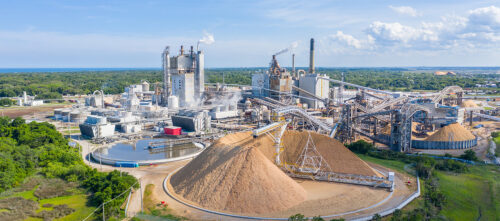
installed at large industrial facilities such as pulp and paper, petroleum,
and petrochemical plants. These plants provided a "thermal host" for the
electric generator.
While on average the European Union countries obtain about the same amount
of their electricity from CHP as the United States (9 percent), the market
interest in CHP has gained in strength in many European countries. The United
Kingdom has seen CHP's share of electricity power production double in the
last decade. Installed CHP capacity has risen to 3.7 GWe in 1997, with
projections of increases to 5 GWe by the year 2000. Similarly, Denmark and
the Netherlands have seen tremendous
growth
in CHP since 1980, with these countries now obtaining more than 30 percent
of their electricity from CHP. Figure ES-4 shows the percentage of national
power production generated by CHP systems in 1997 in a variety of European
countries, along with the United States (Brown 1998; Green 1999).
Markets
The authors have chosen to divide the market for CHP into three categories:
industrial plants, district energy systems, and small-scale commercial and
residential building systems.
The industrial sector represents the largest share of the current installed
capacity in the United States and is the segment with the greatest potential
for near-term growth. Large industrial CHP systems are typically found in
the petroleum refining, petrochemical, or pulp and paper industries. These
systems have an installed electricity capacity of greater than 50 Megawatts
electric (MWe) (often hundreds of MWe) and steam generation rates measured
in hundreds-of-thousands of pounds of steam per hour. Some facilities of
this type are merchant power plants using combined cycle configurations.
They are generally owned by an independent power producer that seeks an
industrial customer for the steam and sells the electricity on the wholesale
market. Sometimes the thermal customer may also contract for part of the
electric power.
District energy systems (DES) are a growing market for CHP. DES distribute
steam, hot water, and/or chilled water from a central plant to individual
buildings through a network of pipes. DES provide space heating, air
conditioning, domestic hot water, and/or industrial process energy. DES represent
an important CHP market because these systems significantly expand the amount
of thermal loads potentially served by CHP. In addition, DES aggregate thermal
loads, enabling more cost-effective CHP. District energy systems may be installed
at large, multi-building institutional campuses such as university, hospital,
or government complexes or as merchant thermal systems providing heating
(and often cooling) to multiple buildings in urban areas. The addition of
CHP to existing district energy systems represents an important area for
adding new electricity generation capacity (Spurr 1999).
With the arrival of low-cost, high-efficiency reciprocating engines, and
the prospect of cost- effective, micro-combustion turbines, CHP is now becoming
potentially feasible for smaller commercial buildings. This area, sometimes
called "self-powered" buildings, involves the installation of a system that
generates part of the electricity requirement for the building, while providing
heating and/or cooling. Packaged systems, such as the reciprocating engines
from Waukesha and Caterpillar, have a capacity beginning at 25 kilowatts
electric (kWe). This size range makes it possible to install CHP in smaller
commercial applications, like fast-food restaurants, as well as larger commercial
buildings.
The CHP supply market is beginning to develop. Besides these above end-use
markets, four major categories of players are emerging:
-
Engineering and construction firms
These groups offer a range of alternatives from design/build to build/own/operate
to comprehensive energy supply/services.
Barriers
Although technologies used in CHP systems have improved in recent years,
significant hurdles exist that limit widespread uses of CHP. Importantly,
these hurdles have the effect of tending to "lock in" continued use of polluting
and less-efficient electricity generation equipment. The main hurdles to
CHP are:
-
A site-by-site environmental permitting system that is complex, costly, time
consuming, and uncertain.
-
Current regulations do not recognize the overall energy efficiency of CHP
or credit the emissions avoided from displaced grid electricity generation.
-
Many utilities currently charge discriminatory backup rates and require
prohibitive interconnection arrangements. Increasingly, utilities are charging
(or are proposing to charge) prohibitive "exit fees" as part of utility
restructuring to customers who build CHP facilities.
-
Depreciation schedules for CHP investments vary depending on system ownership
and may not reflect the true economic lives of the equipment.
-
The market is unaware of technology developments that have expanded the potential
for CHP.
In addition, development of new district energy systems as part of a CHP
implementation face some additional barriers.
Potential
Current
projections foresee a stagnation of the CHP market, with no significant additions
to capacity because of the barriers discussed above (see Figure ES-5).
However, if these barriers are removed, new capacity would likely be built.
Estimating this added CHP capacity is difficult because of the diversity
of system types and potential sites. However, it is anticipated that much
of the early capacity will occur at larger industrial and institutional
facilities that already have boiler systems and thermal distribution
infrastructures (e.g., district energy systems). As time progresses, smaller
industrial, institutional, and commercial facilities will begin to make up
a greater part of the new capacity. New district energy systems, which aggregate
the thermal demands of several facilities or buildings, will take longer
to become a major factor in CHP because of the time required to develop and
grow the piping network. Figure ES-5 presents the results of the analysis
conducted for this report of the potential for CHP capacity with barriers
removed. This analysis draws upon several other studies and analyses. Table
ES-1 summarizes the impacts of this added capacity.
Table ES-1
Impact of Additional CHP Capacity
|
New
Additional CHP (GWe)
|
Displaced
Util. Gen. (TWhe)
|
Cumulative
Additional Capital ($Mill)
|
Net
Energy Savings (TBtu)
|
Net
Savings ($mill.)
|
Carbon
(MMTce)
|
| Industrial (ACEEE) |
|
|
|
|
|
|
| 2010 |
34
|
217
|
22,100
|
1,214
|
5,918
|
34
|
| 2020 |
62
|
396
|
40,300
|
1,995
|
8,825
|
57
|
| DES (Spurr 1999) |
|
|
|
|
|
|
| 2010 |
19
|
148
|
13,860
|
700
|
2,290
|
21
|
| 2020 |
50
|
390
|
19,540
|
1,600
|
5,210
|
51
|
| Small CHP (Kaarsberg
et al. 1998) |
|
|
|
|
|
|
| 2010 |
20
|
NA
|
NA
|
480
|
NA
|
17
|
| 2020 |
40
|
NA
|
NA
|
960
|
NA
|
35
|
| Total |
|
|
|
|
|
|
| 2010 |
73
|
365
|
35,960
|
2,394
|
8,208
|
73
|
| 2020 |
152
|
786
|
59,840
|
4,555
|
14,035
|
143
|
NAnot reported in source
Policies
The U.S. Department of Energy and U.S. Environmental Protection Agency have
committed to double CHP capacity by 2010. This represents a commitment to
add approximately 50 GWe of additional capacity. From the analysis conducted
for this report, this goal appears realistic. Now that this ambitious goal
for expanding CHP capacity has been set, the challenge is to take steps to
convert this goal into action and reality with policies and programs.
Among the options that should be considered are:
-
Reform of environmental permitting regulations and the permitting process
to provide credit for the inherent efficiency of CHP systems.
-
Reform electric utility regulations to provide fair and open access to the
grid for procurement of standby power and excess generation sales.
-
Modernize the depreciation schedules for CHP equipment to reflect current
markets and technologies.
-
Provide financing opportunities and incentives, such as tax credit, to spur
interest in CHP systems.
-
Develop educational and technical assistance programs to increase awareness
of CHP opportunities and technologies.
-
Initiate research and development activities to expand the range of CHP
technologies, especially for small-scale systems.
-
Installation of CHP systems in government facilities to demonstrate the benefits
and provide market leadership.
Conclusions
Combined heat and power can contribute to the transformation of the United
States' energy future. CHP offers significant, economy-wide energy efficiency
improvement and emissions reductions. Our existing system of centralized
electricity generation charts an unsustainable energy path, with increasing
fuel consumption and carbon emissions, while continuing to squander over
two-thirds of the energy contained in the fuel. At least half this wasted
energy could be recaptured if we shift from centralized generation to distributed
systems that cogenerate power and thermal energy. Besides saving energy and
reducing emissions, distributed generation also addresses emerging congestion
problems within the electricity transmission and distribution grid.
CHP represents an opportunity to make significant progress toward meeting
our Kyoto commitments on greenhouse gas reductions. The local air quality
improvements and opportunities for economic growth presented by CHP are equally
compelling. CHP presents an opportunity to improve the "bottom line" for
businesses and public organizations, while also providing a path for improving
the environment.
During the last two years, CHP has become an important element of the national
energy debate. The United States has taken the first steps toward setting
in place policies to promote CHP by establishing a national target. The DOE
and the EPA have begun to review the means for achieving this target. The
target now needs to be translated into concrete policies and programs at
both the federal and state levels for overcoming the significant hurdles
to greater use of CHP.
The private sector also needs to take a leadership role. The primary barriers
to greater CHP use are regulatory and institutional, not technical or economic.
The private sector must work with government regulators and policy makers
to insure that competition and incentives for innovation are preserved, while
creating a favorable regulatory environment for CHP. And the private sector
should actively pursue adoption of CHP both for environmental and
"bottom-line" benefits.
Click here to order this report in hard copy.
40 pp., 1999, $14.00, IE983