Full Site
Publications
Energy Policy
Programs
Press and Media
Consumer Resources
Publications and Meetings
Support
 

Energy Efficiency and the Pulp and Paper Industry

AUTHORS: Lars J. Nilsson, Eric D. Larson, Kenneth Gilbreath, and Ashok Gupta


EXECUTIVE SUMMARY
This report was originally presented at the ACEEE Summer Study on Energy Efficiency in Industry: "Partnership, Productivity, and Environment," held in Grand Island, New York, on August 1-4, 1995. The pulp and paper industry was one of three important industries around which all-day sessions were organized at the Summer Study. In addition to the presentation of this report, the pulp and paper day included presentation of five technical papers on various aspects of energy efficiency in the pulp and paper industry and two 90-minute open discussion sessions led by panelists from industry, electric utilities, government, and universities. The discussion sessions focussed on technological and institutional issues relating to energy efficiency in the industry. The foreword to this report gives the authors' reflections of some of the most important ideas expressed in the discussion sessions. What follows immediately below is a summary of the six chapters in the main body of the report.

1. INTRODUCTION
Pulp, paper, and paperboard mills account for 95% of energy use in the U.S. paper and allied products industry and about 12% of total manufacturing energy use in the U.S. Paper is one of the few basic materials for which per-capita demand has not saturated in the United States. The increase in per capita consumption averaged 1.8% per year from 1960 to 1980, 1.6% per year from 1980 to 1993, and has been projected at 0.6% per year during 1990 to 2040.

The value of shipments from the U.S. paper and allied products industry was $129 billion in 1991, ranking it eighth among all U.S. manufacturing industries. New capital expenditures in the last decade have averaged 10.4% of revenues, making paper and allied products the most capital intensive of the manufacturing industries. The capital intensity of the industry and associated scale economies have contributed to the closing of many smaller pulp and paper mills in recent years.

Wood for pulping represents the largest cost among material inputs to the pulp and paper industry, accounting for an average of 21% of total material and energy costs. The corresponding numbers for energy, wood pulp, and chemicals are 17%, 15% and 6%, respectively. It should be noted, however, that the industry uses about twice as much energy as indicated by these numbers since over half of total fuel and electricity use is self-generated (primarily from spent pulping liquors, wood residues, and bark) and thus does not appear in data on purchased energy costs.

Energy intensity in the paper and allied products industry in 1991 was 21 MJ (20,000 Btu) per dollar value of shipments, ranking it as the second most energy-intensive industry group in the manufacturing sector. The industry has made important strides in reducing total energy use since 1973 and in increasing the fraction of energy provided from self-generated biomass sources. Use of fossil fuels and other purchased energy decreased by about 3% per year between 1972 and 1986, but subsequently leveled off. Self-generation of energy amounted to 56% of total energy use in 1993, up from 40% in 1972.

Environmental concern, manifested in changing market demands and more stringent environmental regulations, is among the most important drivers of technological change in the pulp and paper industry. The health and environmental impacts of bleach plant effluents have generated considerable debate. Emissions are primarily associated with the kraft chemical pulping process, where chlorine or chlorine dioxide is used as a bleaching agent.

Environmental regulation and market demand for chlorine-free products have driven the pulp and paper industry to find alternatives to chlorine as a bleaching agent. Elemental chlorine-free (ECF) and totally chlorine-free (TCF) pulp accounted for an estimated 70% and 30%, respectively, of the bleached chemical pulp production in Finland and Sweden in 1994, up from 25% and 0%, respectively, in 1990. The switch has been driven largely by consumer demand for chlorine-free paper in western Europe.

Environmental concern has also led to increased paper recycling. The fraction of new U.S. paper supply that is recovered for recycling increased from 22% in 1970 to 39% in 1993. More than half of the increase occurred between 1988 and 1993. The paper industry has set a target of 50% recovery by 2000.

2. PROCESSES AND TECHNOLOGIES
Pulping is the process by which the fibers in wood are separated and treated to produce a pulp. The main chemical pulping process--kraft pulping--accounts for about 80% of all pulp produced in the United States. In high-yield mechanical pulping, wood is subjected to shear and compression forces in order to separate the fibers. Recycled paper is repulped through primarily mechanical treatment. Most pulp is pumped as a slurry directly to an integrated paper or paperboard plant where it may be mixed with other pulps, recycled fiber, or fillers such as clay before going to the paper machine. Only about 10-15% of U.S. pulp production is dried for transport to distant users.

The kraft process relies on sulfur and sodium compounds as principal pulping chemicals. Other chemical pulping processes under development include sulfur free processes, some of which use organic solvents, and modified versions of the alkaline sulfite process. Environmental concern associated with kraft pulping is an important motivation for developing these processes since they are free from odorous sulfur compounds and may facilitate bleaching.

The production of paper involves preparing the stock from pulp, forming a sheet, dewatering and drying, and sometimes coating the paper. All paper machines have three basic elements: wet end, press section, and drying section. Economies of scale have resulted in larger and faster paper machines. However, there is a parallel trend toward low cost, simple, and small paper machines for recycled paper minimills.

3. ENERGY USE AND EFFICIENCY
Pulp and paper mills are often large and complex facilities that may produce several pulp and paper qualities from both softwood and hardwood feedstocks. However, it is possible to get an idea of relative energy performance across the industry by focussing on single-product facilities. Bleached and unbleached kraft pulping processes are essentially the same except bleached pulps are cooked to achieve a higher level of delignification in the digester, after which the pulp is bleached. As in most industries, new or modernized plants typically use less energy than old plants. Also, the industry has been more effective in reducing steam demand than electricity demand in new and retrofitted mills. State-of-the-art bleached kraft pulp mills use about 40% less steam and 5% less electricity then typical mills installed in the 1980s. Scandinavian paper and pulp mills are significantly less energy-intensive then U.S. mills, another indication of the substantial energy savings potential here.

Black liquor concentration is usually the biggest single steam using operation in a kraft pulp mill. Evaporators installed in the 1960s and 1970s were built with four or five effects, whereas most kraft mills today use five- or six-effect evaporators, with a concentrator to further increase solids content. Firing the recovery boiler at higher solids content improves overall boiler performance and is a general trend in the industry.

High yield mechanical pulping processes are electricity intensive, and there has been relatively little progress in decreasing electricity demand in mechanical pulping so far. Much of the improvement in energy efficiency has resulted from increased heat recovery where the recovered steam is used to dry the paper. The minimum electricity demand, in principle, to produce mechanical pulp from logs is far below actual electricity use and thus suggests that major improvements should be possible.

Drying of pulp or paper is among the largest steam users at any mill. Drying starts by heating the pulp or paper sheet from the temperature at which it leaves the press section. Important ways of improving the efficiency of paper drying, in addition to higher solids from the press section, include reducing overall heat losses, using less air, and increasing the heat extraction from each unit of steam used for drying. Several technologies to increase solids from the press section and alternatives to the conventional cylinder drying that would impact energy use are being developed or are already in use. More revolutionary drying concepts include the Condebelt process and impulse drying.

Electricity end-uses common to all pulp and paper mills include pumping, air-handling, and lighting. In addition, steam needs and the large number of process streams makes the industry a good candidate for improved heat integration. Information technology--sensors, computers, control systems, etc.--is developing rapidly and offers the potential for higher product quality and lower energy use.

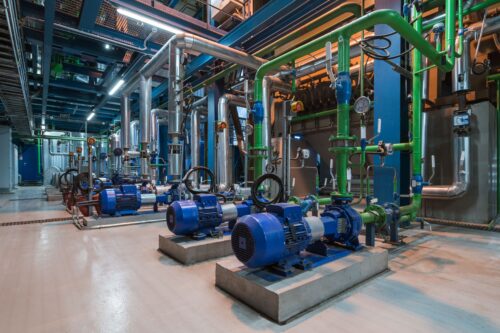
In addition to taking measures to reduce fluid flows, energy use in pumping and air-handling can be reduced by improving pump, fan, and other component efficiencies, reducing flow resistances, and applying variable speed control instead of throttle control. Replacing worn pumps, downsizing oversized equipment, installing variable speed drives, etc., for pumps greater than 50 kW could cost effectively reduce electricity use in pulp and paper mills by up to 30%.

High quality illumination is important for safety and to enhance productivity and working conditions. Lighting typically accounts for only a few percent of mill electricity demand, but this corresponds to several hundred kilowatts of electric load. Modern lighting systems based on high pressure sodium lamps can reduce electricity costs by 50-80% relative to systems with mercury vapor lamps.

Efforts to reduce emissions from pulp and paper mills include external control measures, e.g. waste water treatment plants and electrostatic precipitators, as well as internal process changes, e.g., oxygen delignification with return of more organics to the recovery boiler. External control measures, e.g., an aerated lagoon waste water treatment plant, often increase energy demand. However, the total energy impact depends on technology choice.

Complete elimination of solid waste and of all emissions to air and water from pulp and paper mills is not possible, but general industry goals are for minimum impact mills. The industry is pursuing the concept of "closed cycle" operation as it relates to the bleaching cycle to minimize liquid and gaseous emissions. Some modeling studies suggest that a closed cycle bleached kraft pulp mill may have 10-20% higher steam and electricity demands than a conventional mill due the need to concentrate bleach plant effluents, waste water treatment, and the addition of new processes and equipment. However, some 4-8% more steam can be generated in the recovery boiler due to the return of more organics.

4. BIOMASS-BASED COGENERATION
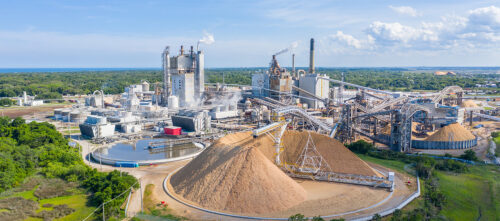
In addition to being the feedstock for pulp and paper production, biomass is also a major energy resource for the industry. Black liquor and solid-biomass residues (bark and hog fuel) generated at the mill and used for energy amounted to some 1.5 EJ (1.4 quads) in 1993. The industry also has access to residues of pulpwood harvesting, some of which can be removed from the forest on a sustainable basis. All black liquor and most mill residues are used at mill sites to fuel cogeneration systems, providing steam and electricity for on-site use. In 1991, the industry generated a total of 54 TWh of electricity, which met 56% of its electricity needs.

Spent pulping liquors account for over 70% of the biomass-derived fuels used in the pulp and paper industry today. Concentrated black liquor from kraft pulping is burned in recovery boilers to both recover process chemicals and generate steam. The chemical recovery system is thus an integral part of the process, with a capital cost of about $100 million or one-sixth of the total cost for a new bleached kraft pulp mill capable of producing 1200 metric tonnes per day of air-dry pulp.

The electricity-to-heat production ratio for a conventional back-pressure steam turbine cogeneration system ranges from 40-60 kWh/GJ (42-63 kWh/MBTU), which is relatively well-matched to the steam and electricity needs at older kraft mills. With this technology, existing mills may not have an incentive to reduce steam use because the cogeneration system may not be able to provide the new steam-to-electricity demand ratio and additional electricity purchases may be required. However, rising electricity-to-heat demand ratios (due to increased electricity loads in mills) are motivating interest in alternative cogeneration technologies. Electricity-to-heat ratios from steam turbine systems can be increased to 60-80 kWh/GJ (63-84 kWh/MBtu) by increasing boiler pressures and temperatures.

Much higher electricity-to-heat ratios are possible using biomass and black liquor cogeneration technologies based on gas turbines rather than steam turbines. Commercially-aimed development of technologies for converting black liquor or biomass residues into combustible fuel gas is ongoing, along with the cleanup systems that would be needed to enable use of the gas in gas turbine cycles. Commercial biomass gasifier/gas turbine systems might be commercially available as soon as the end of the decade. Commercialization of gas turbine systems using black liquor gasification will probably take longer.

Full-scale black liquor gasification/gas turbine cogeneration systems replacing recovery boiler/steam turbine systems will offer higher overall energy efficiency, higher electricity-to-heat ratios, and lower emissions than recovery boilers. An economic window of opportunity for replacing recovery boilers is beginning to open, with many existing recovery boilers approaching the end of their useful lives (Fig. ES2). In addition to the longer-term opportunities for transforming the cogeneration systems at pulp and paper mills, there is interest in black liquor gasification in the near term for non-energy reasons, the most important of which is the affordability that gasification offers for incremental expansion of black liquor processing capacity, the bottleneck to increasing pulp or paper production at many mills.

Perfecting and adopting biomass and black liquor gasification along with combined cycle cogeneration systems could make the paper and pulp industry energy self-sufficient. Assuming production of 50 million air-dry metric tonnes of kraft pulp per year, the total annual electricity production in U.S. kraft pulp mills could be 100 TWh. This is roughly double the amount of electricity self-generated by the pulp and paper industry today. It is equivalent to the total electricity consumption by all pulp, paper, and paperboard mills in the U.S. today.

5. DECISION MAKING AND ENERGY POLICY
Purchased energy and energy-related capital investments represent major production costs in the paper and pulp industry. The variety of corporate philosophies and structures across the industry preclude generalizations about how decisions are made relating to these costs. Some companies have very decentralized structures, with even relatively major energy or non-energy-related investment decisions made at the mill level. In other cases, capital budgets and decision making are centralized and investments require approval from division and/or corporate headquarters.

Traditionally, pulp and paper companies have maintained skilled staff with responsibilities ranging from energy purchases to operation of on-site heat and power generation and energy demand management. However, a general trend in this and other industries is toward reduced staff dedicated to energy, with greater reliance on outside specialist consultants. One positive effect is that good ideas may potentially spread more rapidly throughout the industry. At the same time, there are fewer people on-site with the plant-specific experience that is often crucial to identifying the best opportunities to improve efficiency.

Energy-related investments compete with other investments for capital. The relatively low fuel and electricity prices prevailing since the mid-1980s have reduced the profitability of investments in energy efficiency improvements. In addition, some capital may have to be spent on investments required by regulation. In practice, this means that shorter paybacks are required for pure cost cutting measures. However, many of the best opportunities for improving efficiency will also lead to improved productivity, product quality, environmental performance, or other benefits. For example, introduction of a variable speed drive might save electricity while affording better process control. Providing multiple benefits will increase the likelihood that technical innovations will be implemented.

Many pulp and paper companies have participated in utility DSM programs. These programs generally have encouraged improvements in generic end-use areas, e.g., lighting, compressed air supply, pumping, and air-handling systems. Utilities have been less effective at influencing major process improvements, however. On the other hand, as mills cut their energy staffs, they might be more interested in receiving assistance from utilities in systems and process areas. In order to best assist industries in these areas, utilities will need to develop more innovative and flexible programs that satisfy the needs of individual mills. Providing valued services to major industrial customers could also serve utilities well as electricity markets become increasingly competitive. Without regulatory intervention in a restructured electric utility industry, however, it is widely predicted that utilities will focus on minimizing electricity prices and thereby will go to great lengths to reduce costs, including reducing their DSM budgets.

One key utility-related issue is the extent to which pulp and paper companies will continue to make fuels and electricity production a part of their business or to choose to hire other parties to own and operate the energy assets. Energy experts at some companies think that within two decades many pulp mills will derive as much value from energy ventures as from the pulp itself. At another extreme, some companies are selling off their entire energy complexes to free up capital that can be reinvested in the core business. There is considerable scope for innovative institutional arrangements that fall between these extremes. In one case, Virginia Power and the Chesapeake Corporation are discussing a joint project to replace an old fossil fuel-fired boiler with a natural gas-fired cogeneration plant. Virginia Power would build and own the plant and Chesapeake would operate it. Since power is their core business, independent power producers or utilities could conceivably be more effective than paper companies at operating cogeneration plants as profit centers, and they might be better positioned to adopt new technology.

During the past 15 years, the U.S. Department of Energy (DOE) has funded a variety of R&D projects of interest to the pulp and paper industry including projects on impulse drying, improved sensors and controls, and black liquor gasification. To increase the effectiveness of federal support, DOE and the American Forest and Paper Association are undertaking a major, new, joint research initiative, Agenda 2020, aimed at promoting industrial growth, energy efficiency, and international competitiveness while preserving the environment. An important objective of this voluntary collaborative effort is to leverage industry R&D spending through identifying appropriate areas for joint government-industry R&D and thereby insure that limited funds are spent strategically. This collaborative effort could help the U.S. paper and pulp industry remain competitive with mills located in Scandanavian and developing nations, where much of the recent technological innovation and capacity expansion has occurred.

The pressures on industry to improve environmental performance is also manifested in the development of eco-labelling and international standards. The U.S. Environmental Agency (EPA) has issued guidelines that specify the amount of recycled fiber from post consumer waste that should go into different paper and paperboard products procured by government and federal agencies. Such policies may be effective in addressing some environmental problems, e.g., by reducing the amount of municipal solid waste going to landfills, but may create others, e.g., increased fossil fuel use and related emissions due to recycling if the policies or programs are not properly designed.

6. FUTURE DIRECTIONS
There are potentially major opportunities for improving the efficiency of process energy use in the paper and pulp industry. A number of new energy-saving process technologies, e.g. digesters and paper or pulp dryers, are under development or recently commercialized, and process heat integration (pinch) analysis has been applied in a handful of mills. Capturing the energy savings associated with process-related changes is made more difficult by the generally capital-intensive nature of the required investments. Utility or government-backed energy efficiency programs or policies are more likely to be successful if they address this issue specifically. At the same time, most process-specific changes that bring energy efficiency improvements also bring productivity or other improvements, so that such investments need not be justified on the basis of energy savings alone.

The rate at which energy efficiency will improve in the future will be determined in part by how saved heat and electricity will be valued by the industry, and how fuels and electricity derived from biomass will be valued. This in turn depends on the overall development of energy prices and consumer preferences. For example, more competitive structures in the electricity market in combination with changing consumer preferences could increase the value of electricity derived from renewable sources of energy, which might improve the profitability of pursuing efficiency improvements to maximize electricity sales offsite. However, an equally plausible outcome of competition is lower electricity prices for industry and the decline of utility-sponsored industrial DSM programs. However, utilities may continue to offer energy efficiency services to retain and gain customers in a more competitive environment, although perhaps with fewer financial incentives.

Measuring energy savings and the related return on investments has been demonstrated in other industries and sectors to be crucial to succeeding in capturing energy savings. At present there is no systematic reporting of energy use in the pulp and paper industry, except total industry energy use. Sweden's Forest Industries Association regularly reports the highest, average and lowest energy use per tonne of product for some key products (without disclosing proprietary information), which provides benchmarks against which individual mills can calibrate their energy performance. The U.S. industry might consider such an approach. With greater emphasis on tracking energy use at the mill level, companies would also be able to better evaluate energy performance over time and between different mills within the company.

Reducing process energy needs per tonne of product might have some important cascade effects. It should lead directly to reduced environmental impacts. It might also facilitate quantum improvements in cogeneration technologies for on-site heat and power generation. The pulp and paper industry is in the unique and enviable position of being able to rely on its own internally-generated fuels from renewable biomass sources for more than half of its process energy requirements. In the relatively near future, the industry has the potential to provide essentially all of the energy requirements needed at many of its facilities, and perhaps even sell biomass-generated power to other users.

Advanced biomass-based cogeneration systems, which would provide major improvements in efficiency over existing systems, are undergoing rapid development. Such systems are likely to be commercially ready by around the turn of the century. The pulp and paper industry is a prime initial market for such systems because it has biomass fuels available on-site and because it will be retiring or rebuilding much of its aging chemical recovery boilers and cogeneration equipment during the next decade or so. Increasing competition in wholesale electricity markets may create opportunities for the industry to market renewable electricity directly. The industry might alternatively opt to divest its energy assets and primarily be a supplier of biomass fuels without adding much value to them. The industry would likely benefit in either case, so its taking a leadership role in developing and commercializing such technologies would seem entirely appropriate.

Finally, environmental issues will continue to play a key role in driving technology development and related energy use in the pulp and paper industry. These issues might be most effectively addressed to the benefit of the industry through stronger partnerships with government, utilities, and non-governmental organizations. The Agenda 2020 initiative, which targets the development of environmentally-responsive, energy-related technologies and processes (among a select number of other areas) is a useful initial step in this direction.

100 pp., 1996, $20.00 IE962


Energy Policy | Programs | Press & Media | Consumer Resources
Publications & Meetings | Support ACEEE | Site Map | Home

Copyright Info Here